

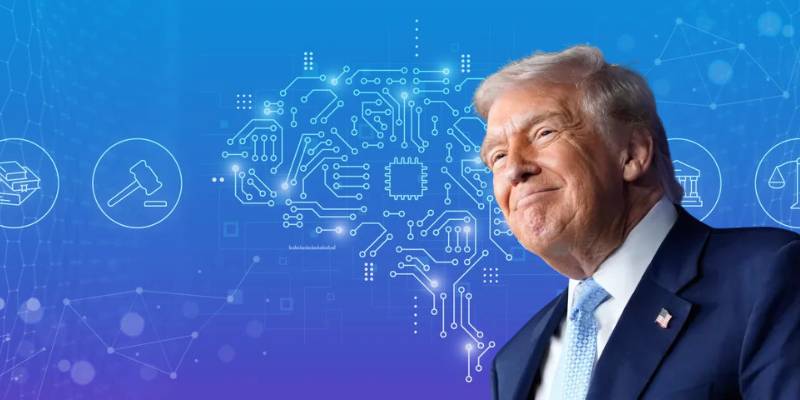
American AI companies already had enough headaches on their hands - privacy concerns around data, bias allegations and job impact showbiz and deepfake fear mongering, to say nothing of it. But there’s a new one now, and it has a very familiar Washington flavor: a power struggle.
Hoping for a slower approach – or total freeze-out Whether states follow lugubrious Nebraska is one thing: But since the days of big-block Republicans and others who raged against state-by-state regulation in the name of consistency of commerce, it’s generally been harder to convince Congresses to move slower.
And so President Trump has thrown his own hat on this particular White House ring in signing an executive order that aims at slowing down (or outright stopping) states from developing their own rules around artificial intelligence.
The pitch is straightforward: one national standard beats 50 different rulebooks devolving into chaos.
And honestly? If you are a company that wants to roll out an A.I. product across the country, you can understand why that might be tempting to hear.
But behind the scenes, lawyers and compliance teams are quietly freaking out because “tempting” does not mean “safe.”
A new legal breakdown explains in detail why businesses should not assume this order now automatically protects them from state laws-and why, overall, this fight is going to get ugly before it gets settled.
The order is quite blunt. It positions state-level AI regulations as an impediment to innovation and national competitiveness, and it urges federal agencies to step in more forcefully – possibly even dangling carrots (or sticks) like funding consequences over the heads of states that go off script.
It’s Washington saying, “We’re driving now.” If you read the text as it came to the White House, it doesn’t conceal that intention at all.
But here’s the difficulty – and this is where it gets sticky in that particularly American way.
States are not just going to shrug and toss it. Some of them have spent years constructing AI rules for hiring, discrimination, transparency, consumer protection and especially child safety.
They have political reasons to appear as if they’re protecting people even as tech races forward. And frankly, they do not like to be told to sit down and shut up.
You can already see the mindset in how forceful attorneys general have been about AI risks, especially when it comes to minors and emotional manipulation as well as unsafe chatbot behavior.
A recent coalition letter that has been making the rounds more or less screams, “We’re watching you.” That kind of pressure doesn’t go away because Trump wielded a pen.
So what does this look like in practice? It also means companies are stuck in a weird twilight in which the federal government is waving a flag saying “uniform rules” while states still have the actual enforcement tools, the local political will and the capacity to pass laws faster than courts can knock them down.
Take Colorado, for instance. It’s already moving ahead with an architecture that addresses “high-risk” AI systems and impacts reminiscent of discrimination.
That law isn’t theoretical. It’s sitting there, on the books, waiting for anyone who just ignores it. And trust me-regulators love examples.
This is when your company starts muttering the same question during every meeting: Okay, so are we in compliance with state rules … or do we bet that the feds will stomp them out eventually?
And the answer that no one wants to hear: Do both.
You continue to comply because you’re afraid of being this week’s dumb headline. You make your legal arguments because you are prepared to use them.
And you document your AI governance as though your life depended on it – because in the court of public opinion (and litigation), the company that’s able to prove it acted responsibly gets points even if its tech still messes up.
And quite frankly, the most likely outcome isn’t some binary “federal wins” or “states win” conclusion.
Something murky is going to happen: selective enforcement, lawsuits, temporary injunctions and companies making decisions based on risk tolerance rather than legal clarity.
Which is why legal analysts are basically offering businesses a straightforward piece of advice: stop expecting that you will be getting a quick answer any time soon – because you won’t.
Already some of the legal commentary is referring to it as a significant “one rule” moment, with the federal government trying to aggregate power in AI regulation the same way it has with other industries previously.
But that doesn’t mean the states are disappearing. It is going to make the next few months look like a chess match - but with moving boards.
Here’s my take, reader to reporter: This isn’t much of a legal story. It’s a power story.
It’s Washington attempting to prevent the states from turning into mini-federal governments. It’s states scrambling to show they can keep people safe better than Congress can.
And it’s A.I. companies that want to ship products without getting body-slammed by lawsuits, A.G. investigations or political blowback.
If you’re a tech business today, you aren’t just developing models – you’re building a survival strategy.
And until something gets finally settled in court, you’re pretty much working in a regulatory thunderstorm hoping the lightning strikes someone else.