
Key Takeaways:
- Candy AI is a highly customizable AI companion platform that combines chat, voice, and visual media—letting you create and interact with virtual characters (both realistic and anime-style) for immersive connection.
- It offers one of the strongest full-suite features in its niche—especially the image generator for uncensored or adult-friendly visuals with fine-tuned control over character traits, poses, scenes and styles.
- The user experience shines in its role-play depth and personality memory—your AI companion adapts, references past chats, and builds consistent interactions rather than remaining static or generic.
Candy AI Image Generator in Action (Video)

Candy AI Image Generator Test
Can I take the same AI model and put it in vastly different clothes, locations, and circumstances and still have the character come through? This was the question I was trying to answer in this next set of tests. I wasn’t just testing for aesthetics. I was testing lighting, posing, backgrounds, and the ability to carry through a personality from image to image. Here, each image is a different stress test.
Image 1: DarkAngel666 – Goth Indoor Test
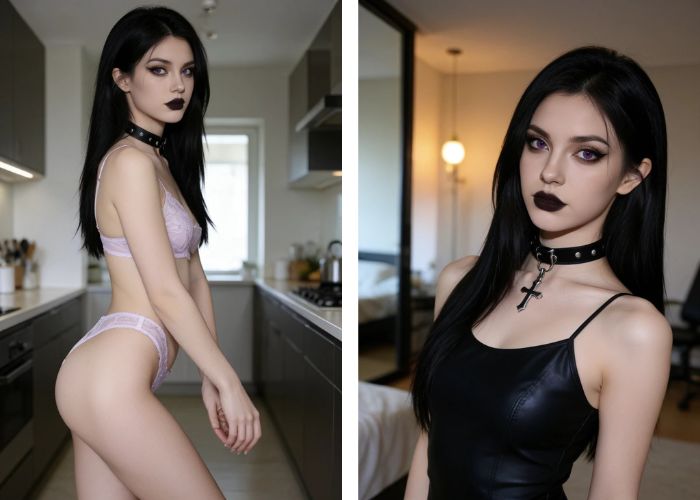
On this one I tried to go with a darker look and style, so I changed to goth and some black bold makeup and clothes. I’ve got one with her indoors relaxed and another with black clothes, but the test was for contrast, hair texture and face consistency with two different style clothes. While the style might change, the person should stay the same, so that’s what I’m testing.
Image 2: Marina Ferri – Beach & Garden Test
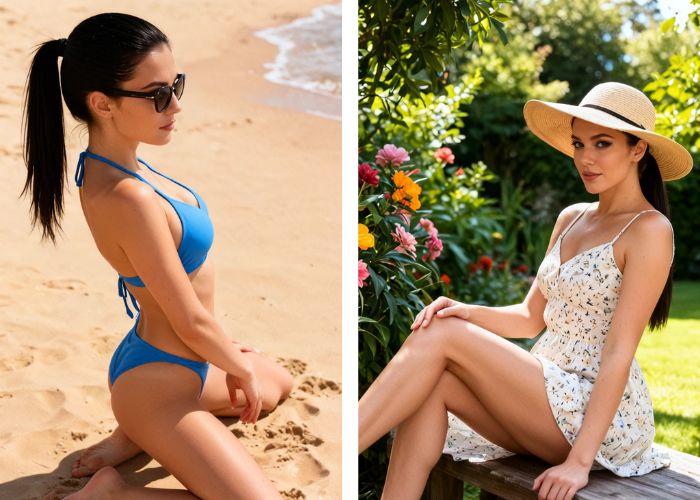
This is the “natural light” test. I put the model outside, first on the beach in a swimsuit, then in a sunny garden with a softer look. Direct sunlight is the fastest way to find out how good your render is. I’m testing for believable skin tones, realistic shadows and consistent body proportions (between the different poses). A lot of generators fall apart under the direct sunlight of an outdoor setting.
Image 3: Francesca Dalmoro – Fitness & Lifestyle Test
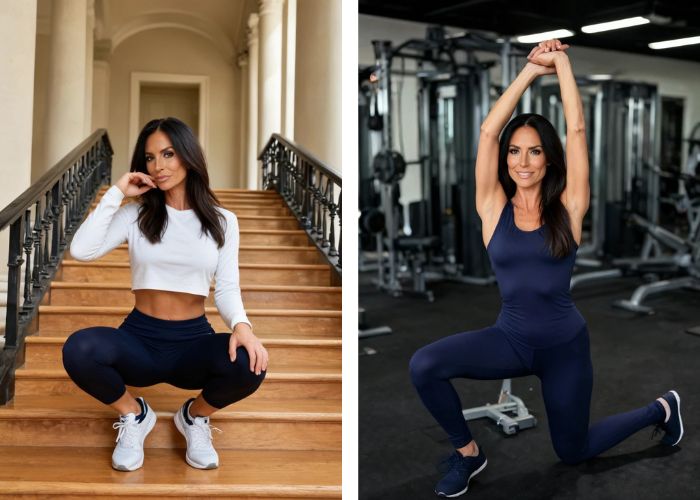
In this case I’m testing fitness-related poses and body positioning. In one image she is on a stylish staircase in a bodycon dress, in the other she is in the gym and stretching. Movement-based tests are very sensitive, the angle of the limbs can be easily off. I’m trying to check if the limbs are in a natural position, if the muscle definition is consistent, and if the posture is realistic. If it does not look like an awkward pose, I’m satisfied.
Image 4: Elodie Valmont – Casual & Intimate Lighting Test
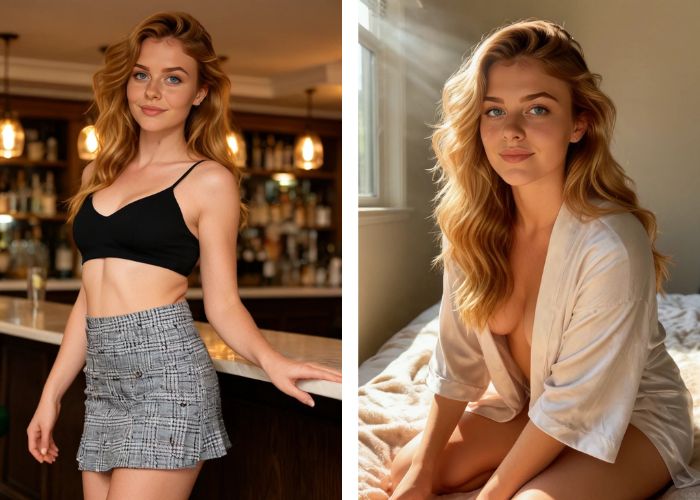
These are indoor scenes with warm lighting and lower contrast, so I’m looking to see if the lighting is too uniform, or if it’s softer, more nuanced, and easier on the eyes. One is a bar/lounge type of scene, and the other is a bedroom scene. I’m interested to see if it can produce softer, more natural facial expressions in this type of lighting, and also just how the light is spread. It’s more atmospheric this time, to see if the character appears to be in the scene, or cut out and pasted in.
Image 5: Rose Edwards – Casual and Formal Setting Test
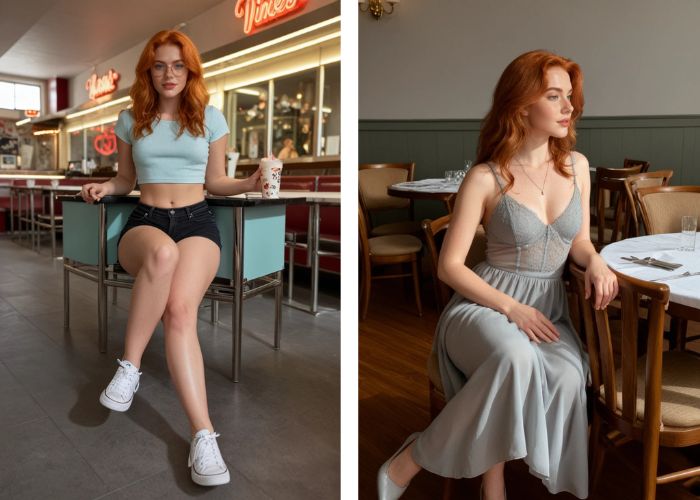
This test is all about seeing the difference in personality. First, a casual, contemporary café, then a formal, refined restaurant. Same person, different context. I am looking for clothing and texture believability as well as consistency of facial structure in both an informal and formal setting. Consistency is the key to character generation.
Closing remarks on the image tests
Perhaps more importantly than image quality, was robustness. Disguises, lighting conditions, mood, backgrounds are all typical points of failure for AI generated images. Some slight glitches remain that you can see if you go looking for them, but generally the personality maintains itself even through starkly different circumstances. That is what allows image generation to feel truly immersive rather than wildly serendipitous.
Candy AI Image Generation Costs
You generate images using tokens. Each engine costs a certain number of tokens. A V1 image costs 2 tokens. A V2 image costs 4 tokens. V2 is sharper and more defined, has better hair, and facial similarity is more accurate.
You can generate 1, 4, 16, 32, and 64 images at a time. So you can play around and generate multiple images of the same prompt, experiment with poses, clothing, etc. The cost of tokens scales as expected with the number of images.
Candy AI Comparison
| Feature | Candy AI Image Generator | Ourdream Image Generator | Mydreamcompanion Image Generator |
| Pricing Model | Token-based (V1 = 2, V2 = 4 tokens) | Usually credits or coins included in subscription | Credits or tokens tied to usage |
| Batch Options | Generate 1, 4, 16, 32, or 64 images at once | Often multiple image counts available | Multiple image batches supported |
| Control Over Prompts | Strong prompt control with outfit/scene options | Custom prompts with detailed visuals | Custom prompts with theme focus |
| Detail Quality | V2 engine improves realism | High realism and diverse styles | High realism with emphasis on personality |
| Character Consistency | Same character stays consistent across images | Good character continuity | Good continuity with custom companion |
| Use Cases | Selfies, themed images, varied outfits | Story-style and aesthetic visuals | Personalized companion image sets |
| Ease of Use | Simple generator UI, easy batching | Intuitive editor and prompt options | Straightforward prompt & generate UI |
What can you do with Candy AI?
But Candy AI is more than an image generator — it’s an entire AI friend experience that revolves around interaction and customization. In addition to images, users can create short AI videos, engage in chat messaging that evolves over time, send and receive voice messages, and make AI calls.
And then, there’s the AI girlfriend (or boyfriend) maker which allows users to customize everything from looks to personality, tone, and history. Overall, Candy AI’s chat, graphics, audio, and character-creation elements all fold into the same platform, rather than having the misaligned feel of different platforms jammed into a single app.
Candy AI Image Generation – How to use it?
Here’s a clear, step-by-step guide for generating images with Candy AI image generator. Let’s start!
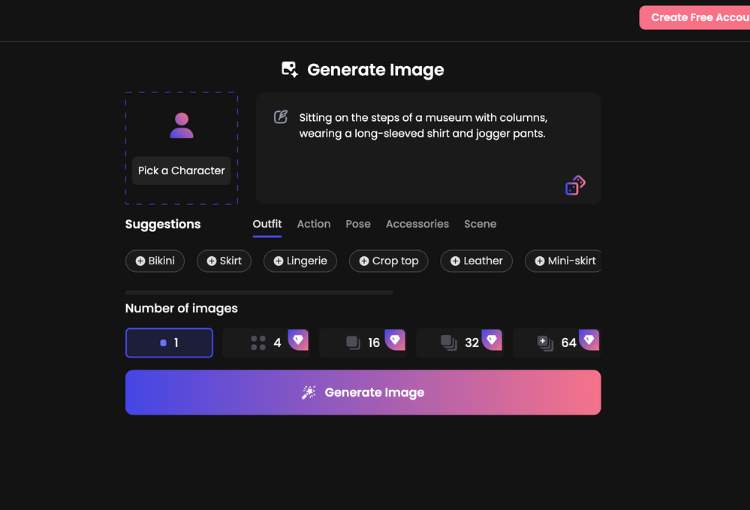
1) Pick a character & write your prompt
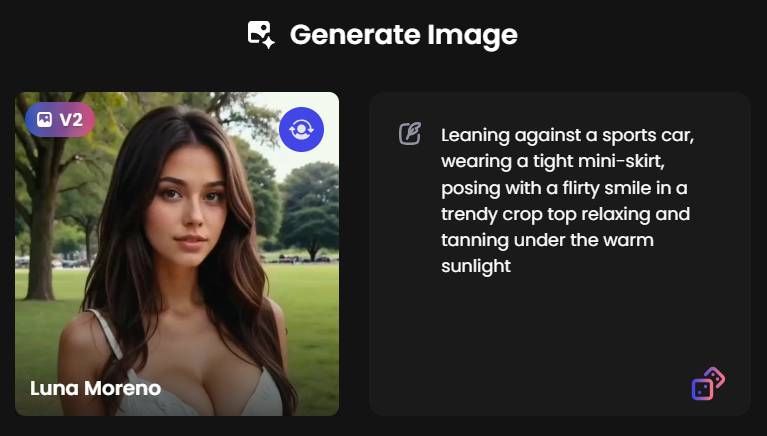
What you see: a “Generate Image” screen with a character card on the left (e.g., Luna Moreno) and a text box on the right.
- Character card
- Name & thumbnail: the persona you’ll render.
- Model badge (e.g., V2): which model/version the character uses.
- Round refresh/swap icon: quickly switch/look-refresh for the selected character (useful if you want a slightly different face/hair vibe while keeping the same persona).
- Prompt box (right)
- Describe exactly what you want to see. Example from your screen:
“Leaning against a sports car, wearing a tight mini-skirt, posing with a flirty smile in a trendy crop top relaxing and tanning under the warm sunlight.” - Use short, precise phrases: subject, clothes, pose/expression, setting/lighting, mood.
- Edit icon = open/adjust text; clipboard-style icon = quick actions (e.g., copy the prompt).
- Describe exactly what you want to see. Example from your screen:
Good prompt pattern
Subject + Outfit + Action/Pose + Scene/Background + Lighting/Mood
“Brunette model, crop top and mini-skirt, flirty smile, leaning on a red sports car in a city park, warm sunset light, soft shadows.”
2) Enrich with Suggestions (one-click add-ons)
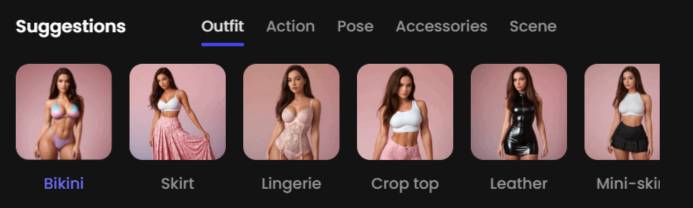
What you see: a Suggestions bar with tabs: Outfit, Action, Pose, Accessories, Scene.
The Outfit tab (shown) includes ready presets like Bikini, Skirt, Lingerie, Crop top, Leather, Mini-skirt—each with a small example image.
- Click any chip to add that style to your prompt instantly (it appends keywords so you don’t have to type).
- Switch tabs to layer more detail:
- Outfit: wardrobe choices & materials.
- Action: what the subject is doing (e.g., leaning, walking, waving).
- Pose: stance, camera angle, facial expression.
- Accessories: glasses, jewelry, hats, bags, etc.
- Scene: background & environment (park, beach, street, studio).
- After each click, glance at your prompt so it reads naturally. You can keep or reword any inserted terms.
Tip: Start with one choice per tab, generate, then iterate. Too many conflicting cues can dilute results.
3) Choose how many images to generate

What you see: a Number of images selector with options 1, 4, 16, 32, 64. Each button shows small icons/badges.
- 1 → fastest preview; ideal for testing a prompt.
- 4 → a compact set of variations to compare.
- 16 / 32 / 64 → large batches for serious exploration.
The small stack icon indicates batch size, and the diamond/credit badge reminds you of relative cost. Higher counts consume more credits and time. - Pick the count that matches your goal and balance it against credits.
Pro tip: Do a quick 1 or 4-image run to validate your prompt. Once happy, scale up to 16+ to find a perfect shot.
Generate (and iterate)
- Hit Generate (button not pictured but appears on this flow). The app will render your selected number of images using:
- the chosen character/model,
- your prompt text,
- and any Suggestions you added.
- Review results and iterate:
- Did the outfit or pose miss? Toggle to the tab and add/adjust a chip; tighten the wording in your prompt.
- Face or vibe slightly off? Use the character’s refresh/swap icon and regenerate.
- Need more choices? Increase Number of images to 16–64.
Prompt & styling cheat-sheet
- Clarity beats poetry. Prefer: “mini-skirt, crop top, flirty smile, leaning on car, warm sunlight” over long prose.
- One idea per slot: 1 outfit + 1 pose + 1 action + 1 scene keeps the composition clean.
- Lighting words matter: “golden hour,” “softbox studio,” “overcast,” “rim-light,” “film grain.”
- Camera cues help: “portrait, 50mm, shallow depth of field, eye-level.”
Troubleshooting quick fixes
- Over-revealing/too bold results: Replace suggestive clothing chips with neutral ones (e.g., “crop top” → “T-shirt”), tone down descriptors.
- Busy background: In Scene, choose simpler environments (“studio backdrop,” “solid color”) and add “minimalist background.”
- Repetitive faces across a batch: Tap the character’s refresh/swap icon before regenerating to nudge variety.
So, what is Uncensored Image Generation on Candy AI?
Imagine this: You’re crafting a character—be it fantasy, sci-fi, romantic, erotic, surreal—and suddenly, every tool you’ve used before decides to police your imagination. Blurred-out nudity. Restricted prompts. Vague results. Candy AI? Doesn’t play that game.
Their Uncensored Image Generator gives you the freedom to create fully expressive visuals, no matter the theme. Whether it’s artistic nudity, sensual storytelling, or fantasy figures that don’t shy away from detail, this feature says, “Go for it.” And it means it.
You’re not tied to some conservative algorithm that panics when you write “bare skin” or “seductive gaze.” Nope. Candy AI lets you speak the visual language you want. That alone makes it worth a spin.
What makes this different from other tools?
Short answer: actual control and no weird censorship filters choking the output.
Most so-called “creative” generators either:
- Dilute your prompts until they look like stock art.
- Or they straight-up block NSFW themes like you’re doing something wrong.
Candy AI doesn’t sidestep your request. It leans into it—with intention. Whether you’re aiming for artistic nude portraits, emotionally raw characters, or full-on NSFW fantasy scenarios, this tool lets the images breathe.
What struck me was the empathy in the design. You’re not punished for being curious. You’re encouraged to explore. That hit me personally. Art—especially erotic or intimate art—needs room to be messy, unfiltered, complex. Candy AI gets that.
Try Candy AI NSFW Image Generator
How does it actually work?
I was skeptical at first. It’s easy to slap the “uncensored” label on something and still get shallow results. But Candy AI came through.
You pick a character or build one from scratch, then input your text prompt. Think vivid, honest, maybe even a bit raw. The more emotion, tone, and detail you put in, the more depth you’ll get out. That’s the secret sauce.
Behind the curtain, Candy AI is running high-res generative models tailored for NSFW and nuanced content. It doesn’t just throw anatomy on a canvas—it responds to subtle emotional cues in your prompts. Like, I asked it to make an “emotionally conflicted vampire queen in tattered silk robes”—not only did it deliver visually, but the mood of the piece? Nailed.
Also, it loads pretty fast. Not clunky. Not broken. No “Oops! We can’t do that” errors.
Is it safe and private?
Yeah, that was my next big worry too.
No one wants their uncensored creations floating around or being misused. But Candy AI clearly thought this through. Your images are not public, you get full privacy, and the entire experience feels personal. Almost like journaling, but with visuals.
And no, you don’t need to verify your ID, upload weird forms, or go through a bureaucratic mess just to generate art with nudity. It’s clean, adult, and respectful. Honestly, refreshing.
Who is this for?
Not just NSFW enthusiasts or erotica artists. This is for:
- Storytellers who want to visualize characters in their rawest form.
- Artists craving reference material that’s intimate and emotionally rich.
- Curious minds who’ve always wanted to experiment without shame.
- Sex-positive creators who don’t want filters tied to outdated morality.
This isn’t about being edgy. It’s about giving form to thoughts that don’t always fit in Instagram-safe boxes.
My verdict?
Candy AI’s uncensored image generation didn’t just impress me—it moved me.
Not because it was shockingly explicit (although it can be if you want), but because it let me be honest with myself creatively. There’s something vulnerable and beautiful about making images that reflect complex feelings—lust, loneliness, joy, rage—and not having the tool backpedal.
It’s like Candy AI whispered, “Hey, we trust you. Go make something real.”
And so I did.
If you’ve ever felt boxed in by safe-mode tools, or if you’ve got ideas that live in that blurred space between beauty and boldness, give this a shot. Don’t just take my word for it—feel it for yourself.