


Climate change is one of those things that’s so big it can feel kind of small. You follow it in the news: glaciers melting, wildfires across the globe, and then you go outside and try to judge for yourself if summers seem hotter.
In between politics, news headlines, and arguments on social media, there’s another climate story playing out. Instruments are taking more data than ever. Satellites are capturing pictures of the planet daily. Scientists are gathering more environmental information than they’ve ever had before.
And more and more, AI is being called in to analyze it all. Not to save the world, but to try to make a dent, with a technology that can be equally unremarkable and remarkable, to try to help us understand the planet a little better and, hopefully, manage it a little better too.
The Climate Data Explosion: Why 2025 Could Be the Year AI Becomes an Environmental Game-Changer
The climate debate has gotten a little strange lately. Yes, the planet is warming. But there’s another phenomenon underway that is just as significant: We’re collecting an unprecedented amount of information about it. I mean an UNPRECENTED amount of information about it. Take a moment to appreciate it.
Just a few decades ago, it was unthinkable that we could be monitoring the planet from space 24 hours a day. Yet, we are. Satellites orbiting the earth every few hours. Ocean buoys floating around measuring temperature and salinity.
Tiny weather stations on farms and in cities and forests and mountains. We’ve basically got the planet on a heart monitor. The scale is almost incomprehensible. NASA’s archive of earth science data now contains over 178 petabytes of information.
That’s 178 million gigabytes of climate information sitting on servers right now waiting to be analyzed. To get a glimpse of what’s available, you can dig into part of the system at NASA Earthdata, which distributes the massive datasets to researchers around the globe. It’s one of the largest open science resources we have. And that’s just the start.
As of 2023, there are at least 1,193 earth-observing satellites circling above us monitoring forests, and glaciers, and oceans, and clouds, and pollution levels and basically every environmental metric we can think of.
The full scope of the network is laid out in a new paper on earth observation satellites on ScienceDirect that describes it as “one of the most extensive systems ever developed for the planet’s monitoring.” In other words, we’re now constantly monitoring the earth. The part nobody wants to admit, however, is that we can’t keep up.
The Real Problem Isn’t Data. It’s Way Too Much Data
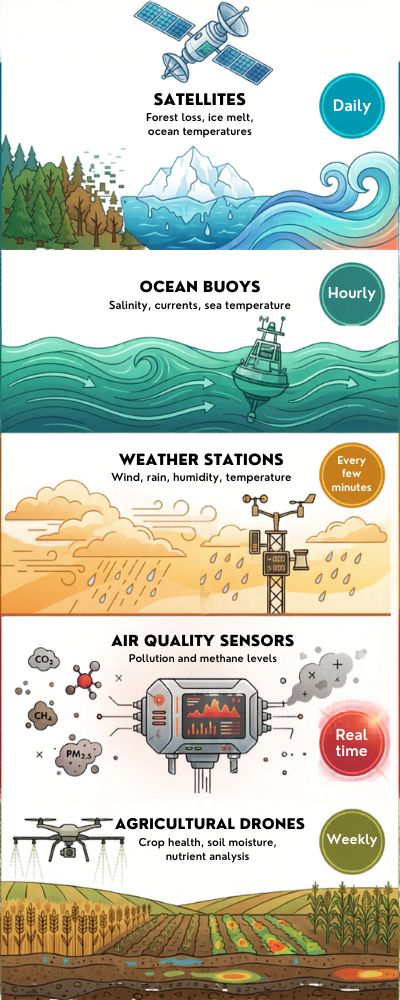
| Data Source | Environmental Information | Typical Frequency |
| Satellites | Forest loss, ice melt, ocean temperatures | Daily |
| Ocean buoys | Salinity, currents, sea temperature | Hourly |
| Weather stations | Rainfall, wind, humidity | Every few minutes |
| Air quality sensors | Pollution and methane levels | Real time |
| Agricultural drones | Crop health and soil moisture | Weekly |
Not that long ago, climate science looked different. Researchers might analyze temperature records from a single weather station, or review a handful of satellite images taken every few days. The datasets were certainly big, but they were still discrete.
A research team could conceivably chomp through them. These days? The data never stops coming. A single satellite can produce terabytes of imagery every single day.
When you multiply this by hundreds of satellites, plus ocean sensors, plus atmospheric monitors, plus environmental drones, the sheer volume of data becomes overwhelming. It’s a bit like trying to sip from a firehose.
You can almost picture a climate scientist firing up their laptop in the morning and seeing the day’s fresh satellite data and thinking to themselves: Well, there goes my weekend. Which is where artificial intelligence comes in.
AI Is Weirdly Good at This Kind of Mess
AI is uniquely suited to this kind of problem. That’s more or less what machine learning was invented for. Given enough computing power, they can review hundreds of thousands, or even millions, of satellite images to identify patterns that no human would ever have noticed. Scientists are already using AI to track deforestation, identify methane leaks, detect coastal erosion, and monitor ice sheets.
There’s a growing body of research in Frontiers in Environmental Science that explores how machine learning is enabling scientists to process environmental data far faster than traditional methods. And it doesn’t stop at data analysis.
AI can help us reduce our emissions in the first place. According to a new report from the International Energy Agency, existing AI technologies could reduce global energy-related emissions by around 5% by 2035 simply by optimizing energy grids, and industry, and transportation systems. 5% doesn’t sound like a lot, but when global emissions are running at around 35 billion tonnes of CO2-equivalent per year, every little bit counts. Not bad for a bunch of algorithms.
| Climate Metric | Estimated Value |
| Global CO₂ emissions annually | ~35 billion tonnes |
| Potential emissions reduction from AI | ~5% |
| Data centre emissions | ~180 million tonnes CO₂ |
Why This Shift Actually Matters
There have been a few years where the news around climate change has felt, well, dark. Record temperatures. Collapsing glaciers. Forests getting clear-cut faster than governments can keep up. Sometimes it feels like we’re doomed to play catch-up forever. But something profound has changed. Because we’re now collecting so much environmental information, and because AI is getting so much better at interpreting it, we’re starting to see changes to the environment almost as they’re happening.
Illegal logging can be spotted from satellite imagery within days. AI-enabled flood models can warn cities of impending disaster before it’s traditionally possible. Smart grids can adjust energy use in real time to minimize energy waste. In other words, for the first time, we can actually see the planet. And once you can see a problem, really see it, it’s a heck of a lot easier to fix it.
By the Numbers: The Most Important Environmental Statistics Shaping 2025
“Facts are stubborn things; and whatever may be our wishes, our inclinations, or the dictates of our passion, they cannot alter the state of facts and evidence.”, John Adams
You’ve probably been in this situation at least once. Someone mentions climate change, and then, boom, the room explodes. Suddenly there are opinions flying everywhere. Somebody cites a study. Somebody else frets about the economy. And somewhere across the dinner table is that person’s uncle who’s telling everyone that it used to be cold back in his day too.
It can get loud.
But here’s the thing about facts: they’re quiet. They don’t fight. They don’t care who wins the argument. They just are. And so every so often it’s helpful to take a deep breath, pause all the arguing, and actually just look at what the facts are telling us.
Global Temperatures
NASA tracks Earth’s temperature as part of its Global Climate Vital Signs program. And according to that data, the planet has warmed by about 1.2°C since the late 1800s.
The first time people hear that number, there’s a moment of pause.
“Wait… only one degree?”
It doesn’t sound like much. Almost nothing. The difference between wearing a sweater or not wearing a sweater.
Except that it’s not a house we’re talking about here. It’s not a room with a thermostat. It’s the entire planet, oceans, forests, deserts, mountains, polar ice caps, everything, that’s warmed by 1.2 degrees. And for something that big to warm even a little bit means there’s a huge amount of additional heat that’s entered Earth’s climate system.
And then there’s the part scientists like to point out: the past ten years have been the hottest on record.
Not one weirdly warm year. Ten years in a row.
That tends to stop the shrugging.
Carbon Emissions
Behind the rising temperatures is the number that drives most climate conversations: carbon emissions.
The International Energy Agency estimates that in 2023 the world pumped about 37.4 billion tonnes of carbon dioxide into the atmosphere.
It’s one of those numbers that’s so huge it’s hard to visualize. Thirty-seven billion tonnes of invisible gas rising into the air above us.
But when you break it down, the sources aren’t mysterious. Electricity generation. Industrial activity. Transportation. That is, the stuff that powers our daily lives.
Coal plants generating electricity. Gas heating buildings. Cars and trucks burning fuel on roads.
Some countries are transitioning to renewables as fast as they can, racing to get off fossil fuels entirely. Other countries are slower. The transition is happening, but it’s patchy. And at times it can feel infuriatingly slow.
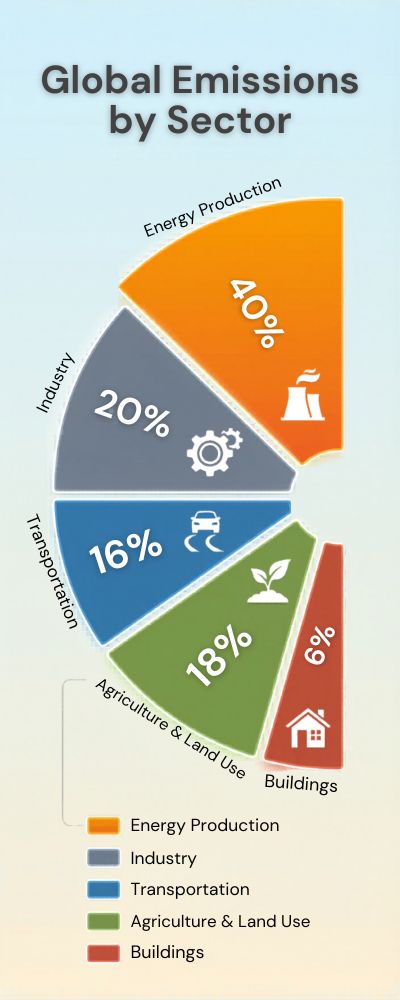
| Sector | Share of Global Emissions |
|---|---|
| Energy production | ~40% |
| Industry | ~20% |
| Transportation | ~16% |
| Agriculture & land use | ~18% |
| Buildings | ~6% |
Forests
Finally, there are the forests, which often get overlooked in climate discussions.
Trees absorb carbon dioxide from the atmosphere and store it in their trunks and branches and roots. In a way, forests are like natural carbon storage systems working quietly in the background. That’s why deforestation is hard to overlook.
The world has lost about 10 million hectares of forest every year for the past decade, according to Global Forest Watch.
That’s roughly the size of South Korea being cleared every year.
While carbon is important, the loss of forests affects more than atmospheric CO₂. Forests are complex ecosystems. Birds nesting in branches. Insects pollinating plants. Mammals moving through dense undergrowth. Underground networks of fungi connecting tree roots in ways scientists are still trying to understand.
When a forest disappears, it’s not just a group of trees being removed. It’s an entire living system coming apart.
| Forest Statistic | Estimated Value |
|---|---|
| Annual forest loss | ~10 million hectares |
| Share of loss in tropical regions | ~40% |
| CO₂ absorbed by forests yearly | ~7.6 billion tonnes |
Oceans
The oceans would probably tell humanity to slow down if they could.
The National Oceanic and Atmospheric Administration (NOAA) says the oceans absorb about 30% of the carbon dioxide humans release into the atmosphere.
That’s a remarkable service the oceans provide for the planet.
But it comes with a trade-off. When seawater absorbs carbon dioxide, its chemistry shifts and the water becomes more acidic. Since the industrial revolution, ocean acidity has increased by around 30%.
That shift creates challenges for coral reefs, shellfish, and many other marine species that rely on stable ocean chemistry. It’s one of those environmental changes that happens quietly beneath the surface, mostly out of sight, yet its effects ripple through entire ecosystems.
| Ocean Indicator | Change |
|---|---|
| CO₂ absorbed by oceans | ~30% of human emissions |
| Increase in ocean acidity | ~30% |
| Global sea level rise since 1880 | ~20–23 cm |
Some Good News: Renewable Energy
Not every statistic in the climate story points in a troubling direction.
Renewable energy has been expanding faster than many analysts once predicted. The International Renewable Energy Agency says global renewable electricity capacity reached about 3,870 gigawatts in 2023, and roughly 86% of all new power capacity added that year came from renewable sources.
That represents a significant shift in the global energy system.
Solar power, in particular, has seen dramatic cost reductions. The price of generating solar electricity has dropped about 89% since 2010, according to IRENA’s renewable energy cost reports.
Which means something interesting has happened: in many places around the world, renewable energy isn’t just cleaner anymore.
It’s also the cheapest.
The Big Picture
When you line all these numbers up next to each other, it starts to feel like two different stories unfolding at once.
One story is worrying. Emissions remain high. Forests continue disappearing. Oceans are absorbing more carbon than they were ever meant to handle.
The other story is cautiously hopeful. Renewable energy is expanding quickly. Technology is improving. Scientists understand Earth’s climate system better than at any point in history.
So which of these trends wins out?
That’s the question hanging over the next decade.
Because the numbers don’t just describe the state of the planet, they reflect the choices humanity is making. And those choices will shape what the next set of numbers looks like.
AI vs. Climate Change: How Machine Learning Is Cutting Carbon Emissions Worldwide
Fighting climate change sometimes feels like being in the ring with a heavyweight boxer. Emissions keep going up, the planet keeps getting hotter, and it often seems like we’re always playing catch-up instead of catching a break.
So it’s worth asking: what if the technology behind our smartphones and computers could also help us clean up the environment? Enter artificial intelligence. AI can process vast amounts of data to identify patterns, the kind of data that climate researchers and scientists use every day.
Energy grids, transportation systems, weather patterns, industrial processes—it’s a lot to handle for a human, but AI can handle it with ease. A report by the International Energy Agency cited that the use of AI in energy management, transportation, and industry could reduce global greenhouse gas emissions by 5–10% by 2030. That may not sound like a whole lot, but every little bit counts. Small gains in efficiency can result in millions (or even billions) of tons of reduced emissions.
AI for Energy Grids
For a long time, the way we managed energy grids was based on predictions. Energy companies would forecast how much energy was needed and produce it. When energy demand spiked or waned throughout the day, grid managers would adjust to compensate. But the grid is a complex system. There are a lot of factors to consider, from how sunny it is outside to how warm it is in your apartment.
Using machine learning algorithms, grid managers can now much better predict energy demand and adjust accordingly. This improves the overall efficiency of the grid and enables utilities to take greater advantage of solar and wind power. According to the IEA’s Digitalisation and Energy report, the widespread adoption of AI in the energy sector could reduce global electricity emissions by as much as 4%.
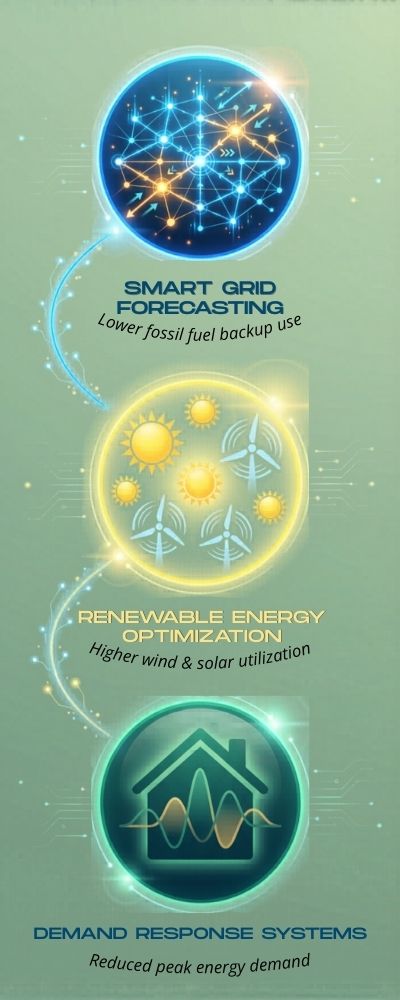
| AI Application | Potential Climate Impact |
|---|---|
| Smart grid forecasting | Lower fossil fuel backup use |
| Renewable energy optimization | Higher wind & solar utilization |
| Demand response systems | Reduced peak energy demand |
AI for Transportation
Did you know that transportation accounts for 16% of all global greenhouse gas emissions? The U.S. Environmental Protection Agency estimates that trucks, airplanes, ships, delivery vans and other modes of transportation account for nearly a fifth of all global GHG emissions. AI can help in some surprising ways.
Logistics companies can now use AI algorithms to reduce the amount of fuel burned by its delivery trucks and planes, by optimizing delivery routes to reduce the number of miles driven. For example, package delivery company UPS implemented an AI-powered routing system that reportedly cut fuel use by about 10 million gallons annually, saving both money and emissions.
| AI Logistics Benefit | Impact |
|---|---|
| Route optimization | Fewer miles driven |
| Traffic prediction | Reduced idle time |
| Fleet efficiency | Lower fuel consumption |
AI for Industry
Heavy industry, including steel, cement, and chemical production, accounts for one fifth of all global GHG emissions, according to the International Energy Agency. Small gains in efficiency at this level can have a huge impact on overall emissions.
AI can help by monitoring industrial processes in real time and detecting when factories and other facilities are being inefficient. When Google applied AI to its data centers to optimize cooling systems, the company was able to cut the amount of energy needed for cooling by 40%, according to research published in Nature.
AI isn’t exactly “free”
Of course, it wouldn’t be fair to say that AI has no environmental footprint of its own. After all, training machine learning algorithms to recognize complex patterns in datasets requires a lot of computer power. And computers use electricity.
In fact, data centers and data networks account for between 1–1.5% of global electricity demand, according to the IEA’s report on data centers and data transmission networks. However, many experts believe that the overall reductions in GHG emissions made possible by AI will far outweigh the amount of energy needed to power the computers themselves.
Where’s the opportunity?
I’m cautiously optimistic about AI’s potential to combat climate change, for one simple reason: unlike many other climate solutions, AI can scale incredibly fast. Once an algorithm is developed and deployed, it can be applied to thousands of power plants, factories, vehicles and energy systems almost immediately.
That’s not something you can say about a lot of other climate solutions. So no, AI is not going to “solve” climate change. But it might just help us build the tools we need to solve it a little bit faster.
Smart Energy Systems: The Rise of AI-Powered Power Grids
The electric grid is one of those things that’s easy to take for granted. You flip a switch and, voilà! The lights turn on. But it’s what goes on behind that switch that’s really impressive: thousands of power plants, transmission lines, substations, wind farms, and solar fields, all working together in perfect harmony.
The thing is, electricity has to be produced at the exact moment it’s consumed. If there’s too little, the lights go dark. Too much, and the grid collapses.
For decades, grid operators balanced the grid using a combination of experience, forecasting tools, and a lot of educated guesswork. Today, AI is lending a hand. The International Energy Agency estimates that digital technologies like AI could reduce global electricity sector carbon emissions by around 4% through better grid management. That doesn’t sound like a lot, but in the global energy system, it adds up to a whole lot of carbon avoided.
Here’s why renewable energy needs smarter grids
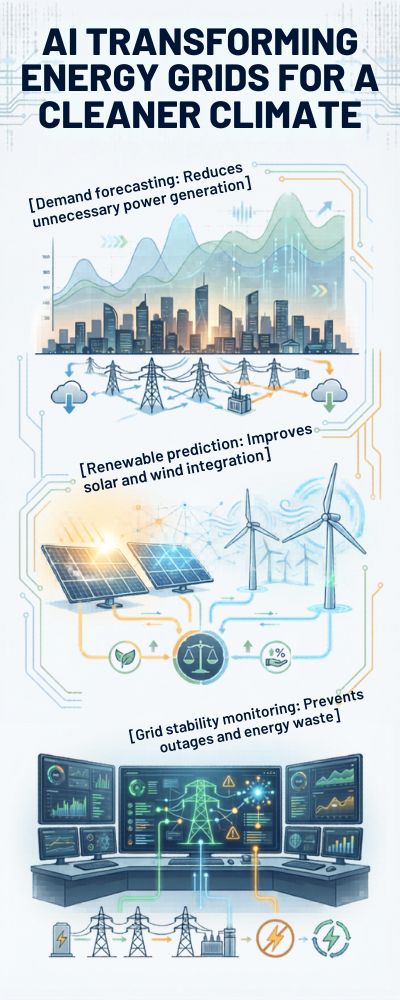
| AI Function in Energy Grids | Climate Benefit |
|---|---|
| Demand forecasting | Reduces unnecessary power generation |
| Renewable prediction | Improves solar and wind integration |
| Grid stability monitoring | Prevents outages and energy waste |
Renewable energy is one of the best tools we have to combat climate change. But it has one big Achilles’ heel: intermittency. Solar panels only produce electricity when the sun shines. Wind turbines only produce electricity when the wind blows. AI can help smooth out the unpredictability of renewables by better predicting both supply and demand.
Predicting the future (sort of)
Machine learning algorithms can predict electricity demand quite accurately. They analyze historical consumption patterns, weather forecasts, seasonal variation, and even cultural and social patterns. It sounds a little weird, but when temperatures rise, people turn on the AC. When a big football game is on TV, electricity use dips during the game and surges at halftime.
AI models can incorporate all of those factors at the same time. Utilities that have deployed advanced forecasting tools have seen improvements in demand prediction of up to 20 to 30%, according to research discussed in energy forecasting studies published on ScienceDirect. That means fewer fossil-fuel peaker plants need to run “just in case.” And that means fewer emissions.
Little things that add up
A lot of climate solutions require big, dramatic changes: new infrastructure, massive investment, international agreements. Smart grids aren’t like that. Much of the benefit comes from a thousand small improvements happening quietly in the background.
For example, AI systems can identify inefficiencies in transmission, detect equipment failures before they happen, and automatically reroute electricity where it’s needed most. The IEA energy infrastructure analysis estimates that smarter digital grid management could save tens of billions of dollars in energy costs globally each year while reducing emissions at the same time.
| Grid Improvement | Result |
|---|---|
| Predictive maintenance | Fewer outages |
| Automated load balancing | Lower energy waste |
| Smart storage integration | Better renewable use |
The intangible benefits
Here’s one thing you don’t find in any spreadsheet: reliability matters emotionally too. When the power goes out in the middle of a heatwave or a winter storm, it’s not just an inconvenience, it can be deadly. Hospitals need electricity. Families need heating and cooling. Entire cities come to a grinding halt without power. Smarter grids don’t just reduce emissions; they make energy systems more reliable.
And personally, that’s what I find most compelling about this trend. AI isn’t replacing the grid, it’s just helping the grid think a little better. A little faster. A little more efficiently. A little less wastefully. Frankly, that’s just the kind of upgrade the planet could use right about now.
Fighting Deforestation With Algorithms: How AI Is Monitoring the Planet’s Forests in Real Time
You don’t see forests in the news often. They’re not the kind of thing that makes headlines. A few trees cut down here, a clearing there, a road slicing through what was once a forest. By the time the news catches up, the forest is gone. It’s a silent process. It’s also a daily one.
According to Global Forest Watch data, the world loses around 10 million hectares of forest every year. That’s roughly the size of South Korea, gone, every year. Forests are more important than you might think. They store carbon. They regulate rainfall. They’re biodiversity hotspots. They support millions of livelihoods.
The Food and Agriculture Organization’s global forest report calculates that forests contain over 662 billion tonnes of carbon, making them one of the planet’s most important natural carbon sinks. So when forests are lost, it isn’t just an environmental issue, it’s a climate one too. This is where AI comes in. Because AI is starting to play the role of a global forest guardian.
Satellites, Algorithms, and a Pair of Very Sharp Eyes
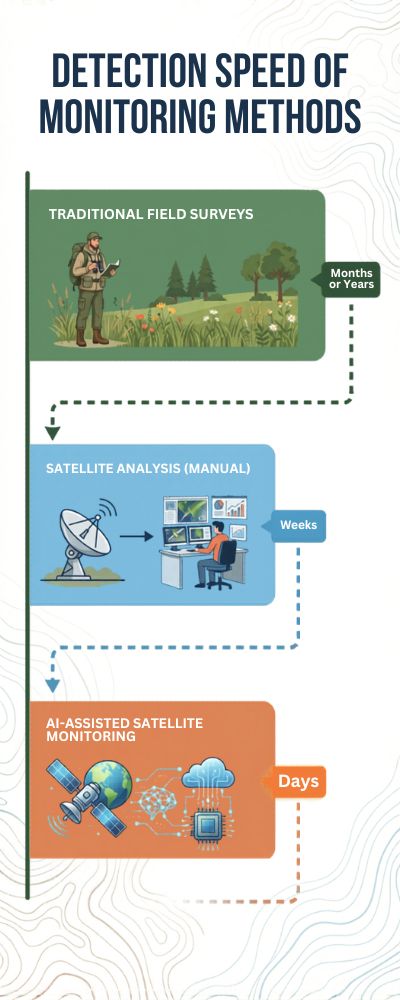
Not so long ago, the best way to track deforestation was with field surveys and the occasional satellite image. It worked, but it was slow. By the time deforestation was spotted, months, or even years, could have passed. These days the process looks very different. Satellites take millions of high-resolution images of Earth every day, and machine learning systems can analyze those images almost as fast.
AI models are trained to recognize the telltale signs of logging, road-building, fires, or agricultural encroachment. Projects like Google Earth Engine use satellite imagery and machine learning to monitor environmental changes on a massive scale. Forest loss can now be detected sometimes in a matter of days, instead of months.
| Monitoring Method | Detection Speed |
|---|---|
| Traditional field surveys | Months or years |
| Satellite analysis (manual) | Weeks |
| AI-assisted satellite monitoring | Days |
The Amazon: A Test Case for AI Monitoring
The Amazon rainforest is often described as the lungs of the planet, and unfortunately, it’s also one of the frontiers of deforestation. Brazil’s National Institute for Space Research uses satellite monitoring systems like PRODES and DETER to track forest loss across the Amazon in near real time. These systems use automated detection tools to analyze satellite images and identify new deforestation alerts in the Amazon basin.
The outcomes are startling. In some areas, AI-assisted monitoring has allowed authorities to identify illegal logging operations within 24–48 hours of forest clearing activities. That kind of rapid response dramatically improves enforcement.
| Amazon Monitoring Statistic | Estimated Value |
|---|---|
| Amazon forest area | ~5.5 million km² |
| Annual deforestation alerts | Thousands detected yearly |
| Detection time with AI systems | 1–2 days |
AI Doesn’t Just Detect Problems, It Predicts Them
This is the part that feels almost sci-fi. Machine learning models are now being used to predict where deforestation is likely to happen next. Scientists use satellite images, road-building patterns, economic activity, and land-use data to identify areas at high risk of forest loss. Research published in Nature Communications shows that predictive AI models can identify potential deforestation hotspots with remarkable accuracy.
| AI Prediction Inputs | What They Reveal |
|---|---|
| Road expansion data | Access points for logging |
| Agricultural activity | Land clearing pressure |
| Population growth | Settlement expansion |
Why This Actually Gives Me Some Hope
Deforestation used to happen out of sight. A forest in a remote region could disappear long before the outside world knew what was happening. That’s changing. Satellites are watching. Algorithms are scanning images every day. Conservation groups are alerted almost immediately when something suspicious turns up in the data.
Does that mean deforestation has stopped? Far from it. But it does mean forests are no longer invisible. And in conservation, visibility is a powerful tool. Once the world can see what’s happening in real time, it’s much harder for destruction to go unnoticed. And, frankly, that in itself feels like a step forward.
Precision Agriculture: How AI Is Helping Farmers Use Less Water, Fertilizer, and Land
Every farmer will tell you roughly the same thing: there’s always been a lot of guessing in agriculture. When will it rain? How much fertilizer should we apply to this field this year? How many more seasons can this soil support crops? For centuries, farmers used a combination of experience, guesswork, and faith. Sometimes, it worked out great. Other times… not so much. But artificial intelligence is starting to help.
Today, farmers are using AI to analyze soil health, weather patterns, crop status, and water requirements. They can even now monitor and manage individual plants, not just whole fields, which reduces waste and increases crop yields.
Agriculture accounts for around 70% of freshwater withdrawals worldwide, according to the Food and Agriculture Organization, so even marginal improvements in water use can make a big difference. That’s where AI-enabled precision farming comes in.
Smart Irrigation: Giving Crops Exactly What They Need
Water is one of the most important resources in farming. Too little, and crops won’t grow well. Too much, and you’re wasting water… or, worse, destroying soil health.
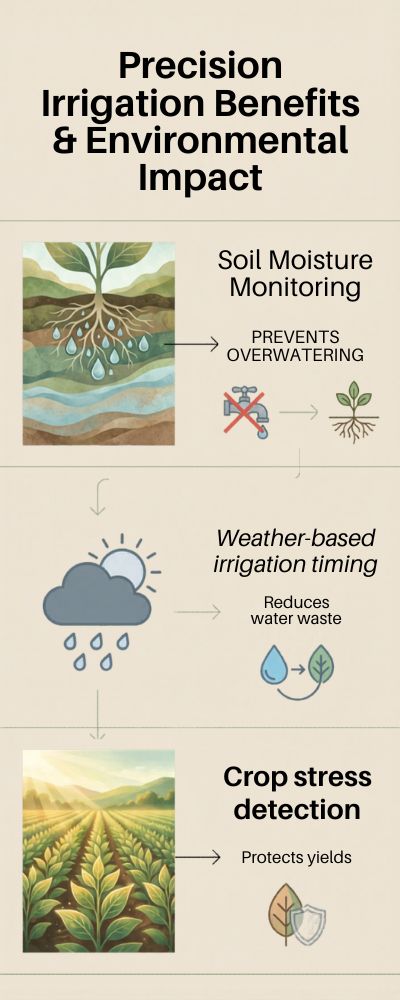
AI-enabled irrigation systems use satellite imaging, soil moisture sensors, and weather data to precisely determine how much water a crop needs and when it needs it. One study published in Nature Food found that precision irrigation systems can reduce water use by 20 to 30% without affecting crop yields.
| Precision Irrigation Benefit | Environmental Impact |
|---|---|
| Soil moisture monitoring | Prevents overwatering |
| Weather-based irrigation timing | Reduces water waste |
| Crop stress detection | Protects yields |
Fertilizer: Using Less While Growing More
Fertilizers help crops grow. But excess fertilizer can run off into streams and rivers, polluting waterways and causing algal blooms. AI-enabled crop monitoring can spot nutrient deficiencies in plants by analyzing images from drones or satellites. Farmers can then apply fertilizer only to the parts of the field that need it, not the whole field. The World Bank’s digital agriculture research found that precision ag can cut fertilizer use by 10 to 20% while still maintaining yields.
Growing More Food Without Expanding Farmland
This is one of those jaw-dropper stats. According to the FAO’s global food security report, the world will need to produce around 60% more food by 2050 to meet the demands of a growing population.
At the same time, we can’t just clear more forests and wild ecosystems to create new fields. So, we have to figure out how to grow more food… without growing our farms. AI-enabled crop modeling can help farmers predict yields, recognize disease early, and time planting more precisely, all of which can increase yields.
| Agricultural Challenge | AI Solution |
|---|---|
| Crop disease outbreaks | Early detection via image analysis |
| Soil degradation | Data-driven soil monitoring |
| Yield variability | Predictive crop modeling |
The Human Side of Precision Farming
When we talk about agricultural tech, it’s easy to overlook the people involved. Farming is an industry, yes, but it’s also a livelihood for hundreds of millions of people around the world. The World Bank says ag provides income for over 2.5 billion people globally.
Technologies that help farmers grow more efficiently can also help them farm more resiliently. When droughts or bad weather or price shocks hit, farmers have more data to inform their decisions. And to me, that seems like one of the best applications of AI. Not to replace farmers, but to help them work with the land just a little bit better.
Cleaning the Oceans With Code: AI’s Role in Tackling Plastic Pollution
Plastic pollution has a funny way of creeping up on you. You take a stroll along a beach and see a bottle cap here, a bag snagged on seaweed there, and maybe an old food wrapper half buried in the sand. At first, it doesn’t seem like a big deal. Just litter.
But step back, way back, and it gets ugly real fast. Researchers estimate that between 8 and 11 million tonnes of plastic enter the ocean every year, according to analysis summarized by the United Nations Environment Programme.
If nothing changes, that number could triple by 2040. That’s not just trash floating around. Plastic breaks down into tiny fragments called microplastics, which end up in fish, seabirds, and even human food systems. So the obvious question becomes: how do you clean up something spread across millions of square kilometres of ocean? Turns out, algorithms might help.
AI Is Becoming the Ocean’s New Scout
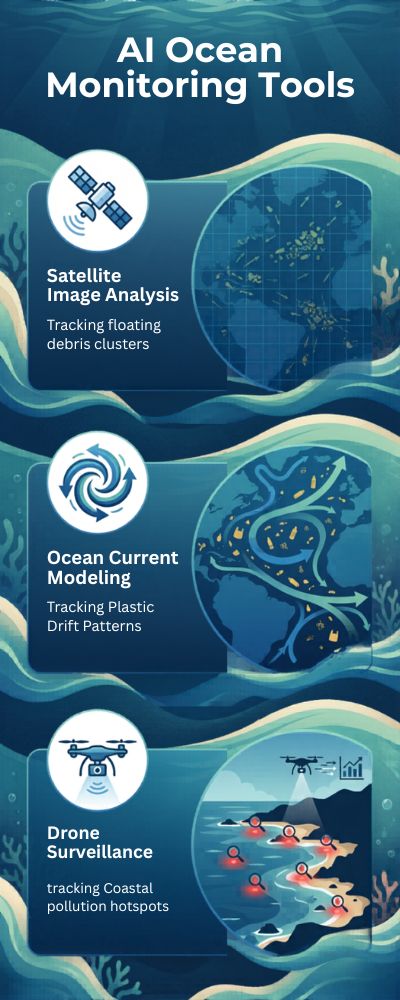
One of the toughest things about dealing with marine plastic pollution is just figuring out where the waste actually is. Plastic doesn’t stay put, it drifts with currents, storms, and tides. Artificial intelligence helps by analyzing satellite imagery, ocean current data, and aerial drone footage to identify likely accumulation zones.
Projects like The Ocean Cleanup initiative use machine learning models to predict where floating plastic will concentrate in ocean gyres, including the well-known Great Pacific Garbage Patch.
| AI Ocean Monitoring Tool | What It Tracks |
|---|---|
| Satellite image analysis | Floating debris clusters |
| Ocean current modeling | Plastic drift patterns |
| Drone surveillance | Coastal pollution hotspots |
Teaching Machines to Recognize Marine Waste
AI isn’t just tracking plastic from space. It’s also being trained to recognize pollution visually. Researchers are using machine learning models to analyze underwater camera footage and identify plastic debris on the seafloor. According to research published in Marine Pollution Bulletin , AI-powered image recognition systems can detect marine debris with over 90% classification accuracy in some environments.
| Detection Technology | Purpose |
|---|---|
| Computer vision algorithms | Identify plastic debris |
| Underwater drones | Survey ocean floors |
| Coastal camera systems | Monitor shoreline waste |
Robots That Collect Plastic
Once pollution is located, the next challenge is actually removing it. Several startups and research groups are experimenting with AI-guided autonomous cleanup robots. Some resemble small boats that patrol harbours collecting floating debris.
Others operate underwater, gathering plastic before it breaks down into microplastics. For example, the AI-powered WasteShark drone, developed by RanMarine, can collect up to 500 kilograms of floating waste per day in rivers and coastal waters, according to data from RanMarine Technology.
| Cleanup Technology | Daily Collection Capacity |
|---|---|
| WasteShark autonomous drone | ~500 kg of debris |
| Ocean skimmer vessels | Several tonnes in ports |
| AI-guided river barriers | Continuous waste capture |
Why Prevention Matters Just as Much
Here’s the honest truth: cleaning the ocean is important, but stopping plastic from entering it in the first place is even more critical. Machine learning models are increasingly used to analyze waste management systems, identify pollution hotspots along rivers, and predict where plastic leakage into the ocean is most likely to occur. Research published in Science shows that about 80% of marine plastic originates from land-based sources, often carried by rivers.
Wildlife Protection in the Age of AI: Using Data to Stop Extinction
You don’t see species extinction in the daily news headlines. Extinction isn’t a specific event that happens one day. Extinction is a slow series of changes: fewer animals, less habitat, different breeding patterns… Until, one day, it’s too late. Here are some sobering statistics. According to the WWF Living Planet Report, the planet has seen an average 69% decline in wildlife populations since 1970. (That’s all wildlife:
- mammals
- birds
- fish
- amphibians
- reptiles)
Of course, not all species are in decline, but you get the picture. The International Union for Conservation of Nature (IUCN) has over 44,000 species currently threatened with extinction. For researchers, one of the trickiest parts of conservation is monitoring animals over vast distances. And that’s where AI is making a difference.
Camera Traps Meet Machine Learning
For years, wildlife researchers have relied on camera traps: motion-sensitive cameras in forests and savannas that capture images of whatever passes by. That’s a lot of photos. Someone has to sort through them. This isn’t anyone’s idea of fun. AI image recognition technology is being used to analyze those millions of photos. Machine learning algorithms can identify species, count individuals, and pick out unusual behavior in seconds.
Researchers writing in Proceedings of the National Academy of Sciences found that AI models can classify wildlife images with over 96% accuracy, greatly accelerating conservation research.
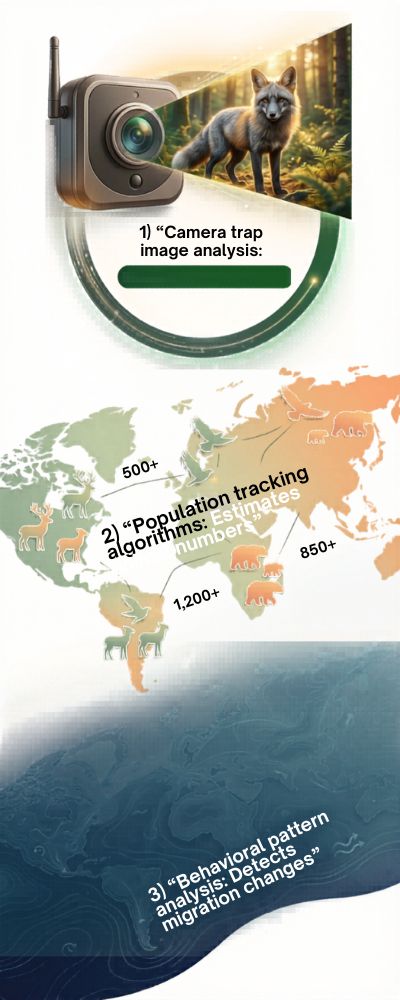
| AI Wildlife Tool | What It Does |
|---|---|
| Camera trap image analysis | Identifies species automatically |
| Population tracking algorithms | Estimates animal numbers |
| Behavioral pattern analysis | Detects migration changes |
Predicting Poaching Before It Happens
Poaching is still one of the biggest threats to endangered species. Rangers patrol enormous protected areas with limited resources to try to catch poachers. AI is helping predict where poachers are most likely to strike.
The conservation tool SMART (Spatial Monitoring and Reporting Tool) uses data on patrol routes, past poaching incidents, and environmental conditions to predict where rangers are most likely to encounter poachers. According to a paper in Nature Communications, predictive analytics has been shown to increase patrol effectiveness by between 30 to 40% in some parks.
| AI Anti-Poaching Strategy | Benefit |
|---|---|
| Risk prediction models | Focus patrols on hotspots |
| Drone surveillance | Monitor remote areas |
| Acoustic gunshot detection | Alert rangers in real time |
Listening to the Forest
Sometimes you don’t need a camera to monitor a forest, you need a microphone. AI-powered acoustic monitoring technology can analyze thousands of hours of audio recordings from remote ecosystems: birdsong, chainsaws, gunshots. Rainforest Connection is a project that deploys solar-powered listening devices into the forest. The devices stream audio data back to machine learning algorithms, which can pick out suspicious noises, chainsaws, say, and alert rangers.
| Acoustic Monitoring Detection | Purpose |
|---|---|
| Chainsaw sounds | Detect illegal logging |
| Gunshots | Identify poaching activity |
| Species vocalizations | Track biodiversity |
Why This Matters More Than Ever
One of the most frustrating things about wildlife conservation is the information gap. Animals range over hundreds of square miles. Habitats are changing fast. By the time researchers realize a population is crashing, it may already be too late. AI won’t stop extinction. But it can give conservationists something they’ve long been missing: visibility.
More data. Faster insights. Earlier warnings. And yes, that matters. Because once we can see what’s happening to wildlife populations in something approaching real time, conservation stops being a guessing game. It becomes a strategy. In the battle to stop extinction, strategy is something we badly need.
Climate Prediction Gets Smarter: How AI Is Improving Weather and Disaster Forecasting
Predicting the weather has always been a bit of a… let’s call it a “guesstimate.” If you’ve lived long enough to remember weather forecasts from long ago, you know what I’m talking about. The weatherperson will say it’s going to rain tomorrow. The next day, you walk outside into a cloudless sky. Not exactly filling you with confidence, is it? Fast forward to the present.
Advances in satellite imaging, computing power, and climate modeling mean today’s weather forecasting is leaps and bounds better. The World Meteorological Organization says that a five-day forecast now is as good as a two-day forecast was in the 1980s. That’s progress. Now, AI is taking weather forecasting to the next level.
Teaching Machines to Read the Atmosphere
Most weather forecasting models use physics to understand what’s happening in the atmosphere. Scientists input temperature, pressure, humidity, wind, and other data into supercomputers, which simulate the behavior of weather systems over time. This works pretty well, but simulating all that physics can be computationally intensive. AI can help.
Rather than simulating physics equations, researchers are training machine learning models to predict the weather based on historical data and observations from satellites.
For example, DeepMind’s GraphCast weather model has demonstrated state-of-the-art performance in weather forecasting. In a recent study, GraphCast proved more accurate than traditional forecasting models on more than 90% of the metrics the researchers measured.
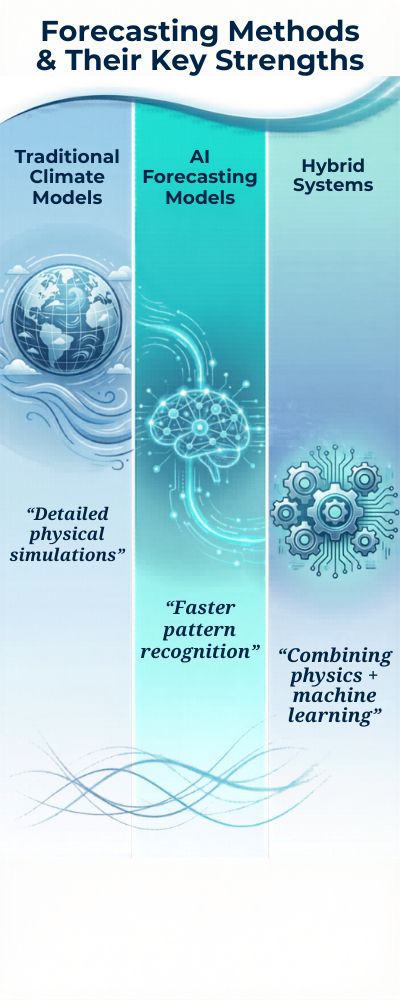
| Forecasting Method | Key Strength |
|---|---|
| Traditional climate models | Detailed physical simulations |
| AI forecasting models | Faster pattern recognition |
| Hybrid systems | Combining physics + machine learning |
Flood Forecasting Is Getting a Boost
One of the deadliest natural disasters on the planet is flooding. According to the World Bank, floods impact over 1.5 billion people around the world. Google has been working with partners around the globe to improve flood forecasting using AI and satellite data.
Their system provides seven-day flood forecasts in several countries, with a particular emphasis on areas where flood monitoring capabilities are scarce. You can check out the Google Flood Forecasting Initiative here. The project hopes to eventually cover hundreds of millions of people in flood-prone areas.
| Disaster Type | AI Forecasting Benefit |
|---|---|
| Hurricanes | Better storm path prediction |
| Flooding | Improved rainfall forecasting |
| Heatwaves | Earlier temperature alerts |
The Carbon Cost of Artificial Intelligence: Can AI Be Green Enough to Save the Planet?
AI is something we often hear about in a positive light when it comes to climate. And, yes, AI is indeed a great tool for tackling climate change. AI can help make our energy grids more efficient, predict natural disasters, monitor deforestation, and count animal populations, just to name a few.
But there is a bit of an elephant in the room here. What if the tool we are using to fight climate change is itself pretty energy intensive? Makes sense.
After all, training those big machine learning models requires a lot of computing power, and computing power requires energy. The International Energy Agency’s report on data centres estimates that, right now, data centres worldwide account for around 1 to 1.5% of global electricity demand.
Now, this does not sound like much, but it is roughly equivalent to the energy consumption of a medium-sized country. Yes, AI has a carbon footprint.
Training AI Models Isn’t Cheap (Energy-Wise)
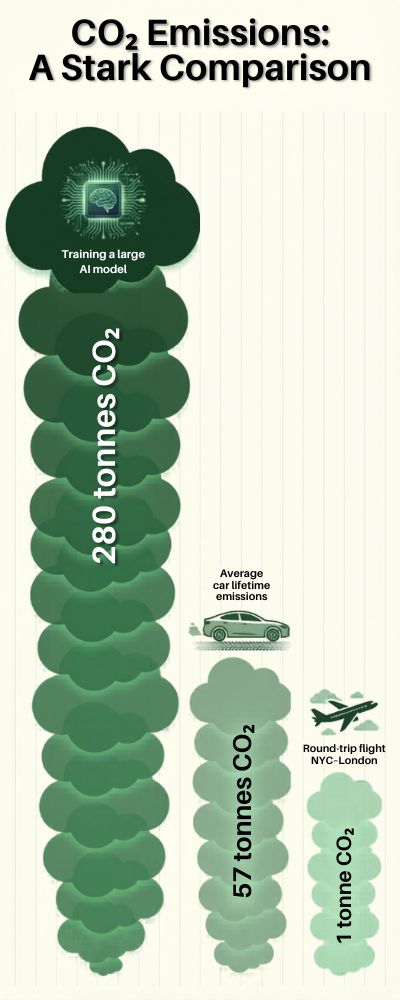
We all know that our shiny AI models are not trained in the blink of an eye. Training a modern AI model requires running thousands of specialized processors on massive data sets for days or even weeks. Researchers at the University of Massachusetts Amherst studied the carbon footprint of AI models and found that in some cases, training a single large natural-language model can emit over 280 tonnes of CO₂.
| Activity | Approximate CO₂ Emissions |
|---|---|
| Training a large AI model | ~280 tonnes CO₂ |
| Average car lifetime emissions | ~57 tonnes CO₂ |
| Round-trip flight NYC–London | ~1 tonne CO₂ |
Data Centers: The Digital Factories of the AI Era
Behind every AI model is a data center somewhere, a giant warehouse of servers that hums 24/7. Data centers store and process data, run algorithms, and generally keep the internet running.
A recent analysis in Nature said that “although computational demands are increasing rapidly, dramatic improvements in chip hardware efficiency and cooling systems have prevented a proportional rise in energy consumption.”
Companies such as Google, Microsoft, and Amazon are also building a lot of renewable-powered data centers. In some cases, these new hyperscale data centers can run on more than 90% carbon-free energy, according to company reports cited in the recent IEA Electricity report. That makes a difference.
| AI Climate Application | Emissions Reduction Potential |
|---|---|
| Smart power grids | Lower fossil fuel demand |
| Transportation optimization | Reduced fuel use |
| Precision agriculture | Lower fertilizer emissions |
AI Can Also Reduce Emissions
But here is the thing that makes this whole AI and climate change thing a bit more nuanced. While AI itself consumes energy, it can also enable massive reductions in greenhouse gas emissions in other sectors.
AI can make logistics more efficient, cut industrial energy waste, optimize energy use in buildings, and make renewable energy systems more productive. In a recent analysis, PwC said that AI-enabled applications could reduce global greenhouse gas emissions by as much as 4% by 2030.
Governments, Tech Companies, and the Race to Build AI for Climate Solutions
A few years ago, the worlds of artificial intelligence and climate policy didn’t have much overlap. AI companies focused on developing more advanced algorithms, and climate policy advocates focused on negotiating new emission targets.
Today, this is changing. Artificial intelligence could potentially play a critical role in solving many of the thorniest challenges in climate policy, including optimizing energy systems, predicting extreme weather patterns, managing agricultural systems, and detecting carbon emissions.
Once this became clear, tech companies and governments started racing to invest in AI climate solutions. An analysis by the Boston Consulting Group suggests that AI-driven climate solutions could reduce 5 to 10% of global greenhouse gas emissions by 2030, if deployed at scale. For a problem as intractable as climate change, that’s no small potatoes.
Governments Are Investing Heavily in Climate AI
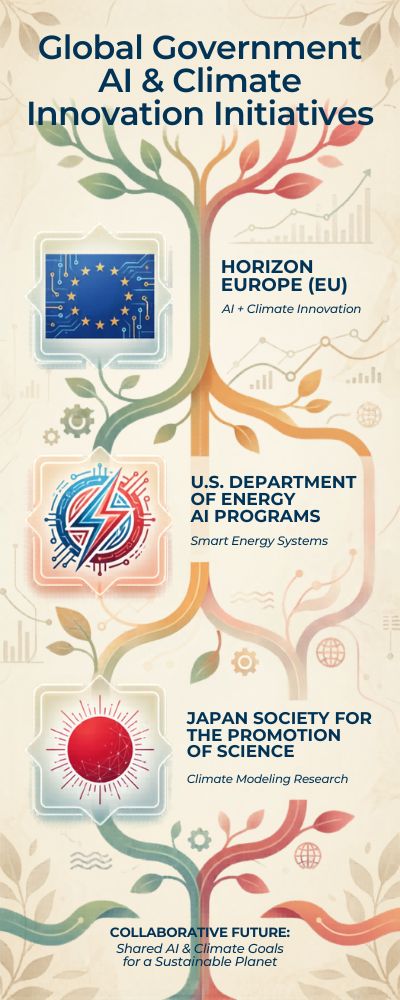
Public funding for climate technology has grown dramatically in recent years. Governments around the world are investing billions of dollars in research programs that combine artificial intelligence, climate science, and clean energy. For example, the European Union has launched a €95 billion Horizon Europe program that will support research in a variety of areas, including AI-powered climate innovation.
(You can learn more about these programs through the European Commission’s Horizon Europe program website.) In the United States, the federal government has increased funding for climate research through programs supported by the Department of Energy and the National Science Foundation, among other agencies.
| Government Initiative | Focus Area |
|---|---|
| Horizon Europe (EU) | AI + climate innovation |
| U.S. Department of Energy AI programs | Smart energy systems |
| Japan Society for the Promotion of Science | Climate modeling research |
Startups Are Joining the Race
Sometimes the most important innovations come from the smallest players. Climate tech startups have received tens of billions of dollars in venture capital investment in recent years.
According to PwC’s climate tech investment report, global climate tech funding topped $70 billion per year in recent investment cycles. Many of these startups are applying AI to solve niche environmental problems, like tracking carbon, monitoring supply chain emissions, and optimizing energy use.
| Startup Focus | AI Application |
|---|---|
| Carbon accounting | Automated emissions tracking |
| Agriculture tech | Crop prediction models |
| Energy analytics | Smart grid optimization |
A New Kind of Climate Collaboration
One of the most interesting things about this new investment in climate AI is the diversity of actors involved. Governments are providing funding and regulatory support. Tech companies are contributing computing power and research talent. Startups are experimenting with new ideas that larger organizations might not risk trying.
It’s a messy process. Sometimes it’s competitive. Occasionally it’s chaotic. But it’s also promising. That’s because climate change is a problem that no single institution can solve alone. It will require the efforts of scientists and policymakers, engineers and entrepreneurs, all working in roughly the same direction.
If artificial intelligence can help coordinate those efforts, even a little, that would be one of the most valuable applications of the technology yet.
The Future of AI and the Planet: Environmental Breakthroughs We May See by 2030
There’s huge potential for AI in energy management. Solar panels, wind farms, electric vehicles and battery storage are all being added to the grid, making it harder and harder to manage.
AI smart grids could adjust supply and demand in real-time and predict when renewables will be generating energy, hours (or even days) in advance. As over 80% of new power capacity added globally is now renewables, according to the International Renewable Energy Agency, this is increasingly important.
| Future Grid Feature | Environmental Benefit |
|---|---|
| AI demand forecasting | Lower energy waste |
| Automated energy storage control | Better renewable integration |
| Real-time grid balancing | Reduced fossil fuel backup |
Hyper-Precise Environmental Monitoring
We’re already monitoring the earth from space. The next step could be even more precise.
AI can assess data from satellites, drones, sensor networks and more to monitor forests, oceans and wildlife populations. Hundreds of petabytes of data are being used by projects funded by initiatives like NASA Earthdata, to give scientists a granular view of the planet. By 2030, these monitoring systems will become far more automated.
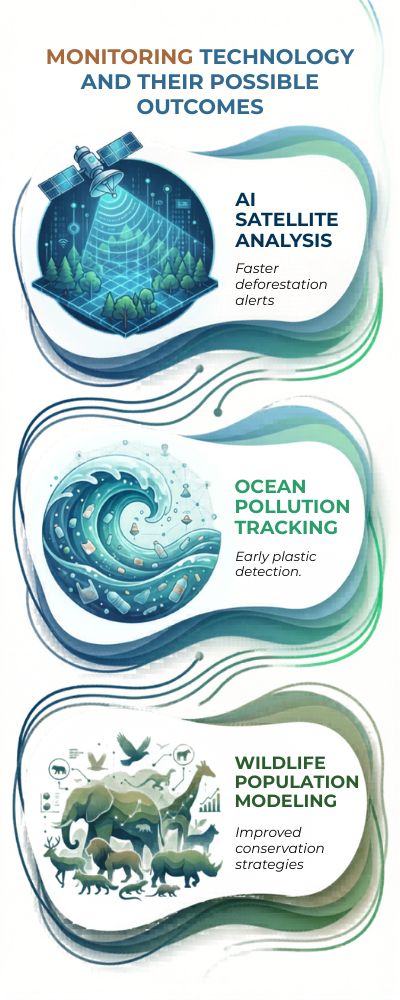
| Monitoring Technology | Possible Outcome |
|---|---|
| AI satellite analysis | Faster deforestation alerts |
| Ocean pollution tracking | Early plastic detection |
| Wildlife population modeling | Improved conservation strategies |
Agriculture That Uses Far Fewer Resources
How will we feed a growing global population without destroying the planet? The Food and Agriculture Organization estimates that by 2050 we will need to produce 60% more food. That’s a scary statistic.
But AI-enabled precision agriculture could help farmers produce more with less. Sensors, soil analysis and crop monitoring mean that water, fertiliser and pesticides can already be targeted and only used where they are needed.
| Farming Innovation | Environmental Impact |
|---|---|
| AI crop health monitoring | Reduced pesticide use |
| Precision irrigation | Lower water consumption |
| Yield prediction models | More efficient land use |
Taking all of this into account, if there’s one thing that can be said it’s that technology and the environment are intertwined in complex ways. AI can guzzle electricity, but it can also make power grids more efficient.
It can’t prevent hurricanes or famines, but it can tell us that they’re on their way. It can’t save rainforests, coral reefs, or endangered species, but it can give scientists and communities the best chance of saving them.
AI is just another tool, and its impact on the climate is just another step in the story of how humans have always tried to make sense of the world around them.
Whether it will be a key to saving the planet, or just another tool that we find ways to misuse, will be less about the machines we build and more about the decisions we make to use them. And that, for now, remains in our hands.
Sources:
- Food and Agriculture Organization of the United Nations (FAO). (2020). Global Forest Resources Assessment. Available at: https://www.fao.org/state-of-forests/en/
- Food and Agriculture Organization of the United Nations (FAO). (2023). The State of Food Security and Nutrition in the World. Available at: https://www.fao.org/state-of-food-security-nutrition/en/
- Google DeepMind. (2023). GraphCast: AI Model for Faster and More Accurate Global Weather Forecasting. Available at: https://deepmind.google/discover/blog/graphcast-ai-model-for-faster-and-more-accurate-global-weather-forecasting/
- Google Research. (2024). Flood Forecasting Initiative. Available at: https://sites.research.google/gr/floodforecasting/
- Google Earth Engine. (2024). Planetary-Scale Environmental Data Analysis Platform. Available at: https://earthengine.google.com/
- International Energy Agency (IEA). (2024). CO₂ Emissions in 2023. Available at: https://www.iea.org/reports/co2-emissions-in-2023
- International Energy Agency (IEA). (2024). Digitalisation and Energy. Available at: https://www.iea.org/reports/digitalisation-and-energy
- International Energy Agency (IEA). (2024). Energy and Artificial Intelligence. Available at: https://www.iea.org/reports/energy-and-ai
- International Energy Agency (IEA). (2024). Data Centres and Data Transmission Networks. Available at: https://www.iea.org/reports/data-centres-and-data-transmission-networks
- International Energy Agency (IEA). (2024). Electricity Market Report. Available at: https://www.iea.org/reports/electricity-2024
- International Renewable Energy Agency (IRENA). (2019). Innovation Landscape for a Renewable-Powered Future. Available at: https://www.irena.org/publications/2019/Feb/Innovation-landscape-for-a-renewable-powered-future
- International Union for Conservation of Nature (IUCN). (2024). The IUCN Red List of Threatened Species. Available at: https://www.iucnredlist.org/
- NASA. (2024). Global Climate Change: Vital Signs of the Planet. Available at: https://climate.nasa.gov/vital-signs/global-temperature/
- NASA. (2024). Earthdata: Earth Science Data Systems. Available at: https://www.earthdata.nasa.gov/
- National Oceanic and Atmospheric Administration (NOAA). (2023). Ocean Acidification Resource Collection. Available at: https://www.noaa.gov/education/resource-collections/ocean-coasts/ocean-acidification
- Proceedings of the National Academy of Sciences (PNAS). (2018). Automatically Identifying Wildlife in Camera Trap Images Using Deep Learning. Available at: https://www.pnas.org/doi/10.1073/pnas.1719367115
- PwC. (2021). Sizing the Prize: What’s the Real Value of AI for Your Business and the Planet? Available at: https://www.pwc.com/gx/en/issues/analytics/assets/pwc-ai-analysis-sizing-the-prize-report.pdf
- Rainforest Connection. (2024). AI-Powered Acoustic Monitoring for Forest Protection. Available at: https://rfcx.org/
- ScienceDirect. (2023). Earth Observation Satellites and Environmental Monitoring Research. Available at: https://www.sciencedirect.com/science/article/pii/S0048969723072121
- The Ocean Cleanup. (2024). Ocean Plastic Interception Systems. Available at: https://www.theoceancleanup.com/
- University of Massachusetts Amherst. (2019). Energy and Policy Considerations for Deep Learning in NLP. Available at: https://arxiv.org/abs/1906.02243
- World Bank. (2023). Disaster Risk Management Overview. Available at: https://www.worldbank.org/en/topic/disasterriskmanagement
- WWF. (2022). Living Planet Report. Available at: https://livingplanet.panda.org/en-us/