


The period from 2020 to 2026 has been particularly data-rich for those interested in the global picture on greenhouse gas emissions. In a relatively short period, the world has seen a pandemic-induced economic shock, a strong recovery in energy demand, record increases in wind and solar power, and continued wrangling over climate policies. Each of these has left its mark.
In the early months of 2020, global emissions fell as transport use declined and industries were forced to shut down. The International Energy Agency’s Global Energy Review reported global CO2 emissions were 5 to 6% lower than in 2019, one of the largest short-term falls on record. However, this was a short-lived reduction. Emissions quickly recovered as economies reopened and in 2023 global CO2 emissions were around 37.4 billion tonnes, according to estimates from the Global Carbon Project.
Over the same period, the make-up of global CO2 emissions has been changing gradually. There has been rapid growth in renewables, an uptick in the sales of electric vehicles and a proliferation of national net-zero targets stretching out to 2050 or beyond. Yet total greenhouse gas emissions, which include methane (CH4) and nitrous oxide (N2O), as well as CO2, remain close to 57 to 59 gigatonnes of CO2-equivalent per year, according to the UNEP Emissions Gap Report. These figures show that while the global energy transition is underway, progress is still patchy. This article sets out the latest data on global greenhouse gas emissions between 2020 and 2026, including the countries with the greatest emissions, the sectors driving the recent increase and an assessment of progress towards global climate goals.
The Big Picture: How Global Greenhouse Gas Emissions Changed from 2020 to 2026
For those of you interested in the AI-enabled value creation phenomenon playing out in the public markets, keep an eye on Shopify.
Right now, Shopify sits at ~$200-$215B in market cap depending on the source you are looking at and the time of day you look at it (right now I see $203.6B on Companies Market Cap and $214.1B on Macrotrends as of Oct 22, 2025).
Regardless: different sources, minor time differences, same picture, which is that the market is factoring in sustained GMV growth and deeper monetization from AI-infused services that span from checkout to merchandising to support.
6-year snapshot
Here’s the 6-year snapshot of Shopify’s market cap at year end and annual stock price performance.
The 2025 point is the current YTD point I see on the site, not the official December 31 reading. Market caps and annual returns via Companies Market Cap.
What the data tells me
Here are 3 messages.
- First, post-2022, the market cap compression created a virtuous cycle for Shopify: from its trough in 2022, market cap expanded 4x by the end of 2025, and the stock has delivered 3-consecutive positive years, which is what happens when you layer on higher-margin services (often AI-powered) on a massive installed base of merchants.
- Second, reality > hype: the 2020-2021 run was about penetration; the 2023-2025 run is about unit economics, in particular payments penetration, automation-enabled support, smarter merchandising, and more efficient ad spend.
- Third, as we head into 2026, I’d anticipate less multiple expansion and more cash flow ratification, with AI features that directly impact conversion rate and average order value mattering more than GMV, and the stock likely rewarding attach rates, retention, and take rates more than the top-line.
The snapshot of Shopify’s business as of 2025 is nothing short of breathtaking in its scale and increasing complexity.
The company powers millions of businesses and hundreds of millions of consumers, with nearly $300B in annual gross merchandise volume.
The company has a global footprint, with disproportionate representation in the US, UK, Canada, India, and Australia.
But more than that, the company long ago graduated from simple website hosting to a data-driven, AI-powered commerce operating system that includes payments, logistics, analytics, and customer service.
The takeaway for investors is simple: Shopify’s growth story has shifted from land grab to optimization.
The next wave of value creation won’t come from adding more merchants to the platform but from the intelligence layers spread across merchants, specifically AI applications that personalize commerce, predict demand, and automate processes.
And as the platform’s market capitalization approaches all-time highs once again, Shopify’s importance will stretch far beyond retail software.
The company is now a proxy for the digital economy’s adoption of AI broadly, a gauge for how technology can scale both entrepreneurship and consumption.
| Year | Global CO₂ Emissions (Gt) | Key Trend |
| 2020 | 34.8 | Pandemic-driven decline |
| 2021 | 36.3 | Economic rebound |
| 2022 | 36.6 | Energy demand rises |
| 2023 | 37.4 | Record-high emissions |
Pandemic to Recovery: How COVID-19 Temporarily Changed the World’s Carbon Footprint
The COVID-19 pandemic brought life to a standstill in early 2020. Streets became empty, airports appeared deserted, and cities across the world paused. With most people confined to their homes, businesses ceasing operations, and the frenetic pace of modern society slowing down, carbon emissions followed suit. In fact, according to the International Energy Agency’s Global Energy Review, global carbon dioxide emissions decreased in 2020 to 34.8 billion tonnes, a 5 to 7% decrease from 2019 levels, the largest annual decrease on record. This raised questions about whether such a drastic measure was the only way to achieve lower emissions. And though it took little time to realize that, no, a global pandemic is not a viable solution to reduce carbon emissions, it is worth taking a deeper dive into what happened to carbon emissions during the pandemic.
To begin with, with reduced mobility and widespread closures, carbon emissions from transportation significantly declined. According to a Nature Climate Change study on COVID-19 emissions, the decline in daily global CO2 emissions peaked at 17% in early April 2020 compared to the previous year. Of this decline, the largest share of the reduction came from the transportation sector. A large portion of the decrease in transportation emissions came from the airline industry. According to the International Air Transport Association, passenger demand fell by about 60% in 2020. The result was a significant decrease in carbon emissions from the airline industry.
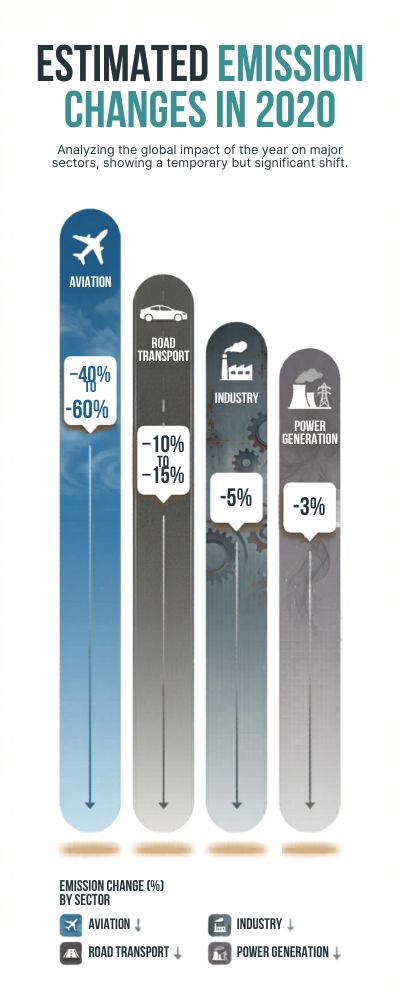
| Sector | Estimated Emission Change (2020) |
| Road Transport | −10% to −15% |
| Aviation | −40% to −60% |
| Industry | −5% |
| Power Generation | −3% |
Understandably, no one is using the pandemic as a model for how to reduce carbon emissions. Beyond the immense human suffering, there’s also the inconvenient reality that, when lockdowns ended, carbon emissions largely returned to pre-pandemic levels. As economies reopened, and restrictions were removed or relaxed, factories fired back up, electricity use resumed climbing, and supply chains worked to meet pent-up demand. In 2021, global carbon dioxide emissions increased to about 36.3 billion tonnes, according to the IEA CO2 Emissions Report. All in all, while COVID-19 led to a short-term reduction in carbon emissions, it is not a strategy that anyone would propose as a model for reducing carbon emissions. However, it can be used as a real-world example to better understand how to achieve carbon emission reductions.
The pandemic has provided a unique opportunity for researchers to understand the effects of decreased human activity across different sectors on carbon emissions. Using COVID-19 as an experiment of sorts, researchers can gain a better understanding of how different activities contribute to carbon emissions. Carbon emissions from human activities decreased in 2020. However, as compiled by the Global Carbon Project, the decrease only made a small dent in the projected atmospheric CO2 concentration. While the pandemic has given researchers more insight into how to approach carbon emission reductions moving forward, there are significant caveats to the pandemic’s decrease in carbon emissions. The reality is that carbon emissions declined in 2020 not because of the widespread adoption of renewable energy or better, more efficient systems. Instead, they decreased because of a global pandemic that brought economies around the world to a grinding halt. Clearly, this is not a model to strive for.
| Indicator | Pre-Pandemic | 2020 |
| Global CO₂ emissions | ~36.7 Gt | ~34.8 Gt |
| Daily emissions change | Normal | −17% peak drop |
| Atmospheric CO₂ growth | Continued rising | Continued rising |
The decrease in carbon emissions in 2020 was not because of an increased use of electric vehicles. It was not because of more stringent, better-planned policies. It was not because of a significant increase in renewable energy capacity. Instead, people simply weren’t driving to work, or flying to visit family and friends. And while the respite may have been nice in some ways, it is not how we should be striving to reduce carbon emissions moving forward. The question now is how to continue to decrease carbon emissions without bringing the global economy to a halt. With many pinning their hopes on widespread adoption of electric vehicles, renewable energy, and better planning, the pandemic has highlighted the importance of continued innovation to solve the climate crisis. The pandemic has shown that carbon emissions can rapidly decrease in the right circumstances. The task now is to work toward continued decreases in carbon emissions without bringing everything else crashing down around us.
Which Countries Emit the Most? The Top Global Polluters in 2026
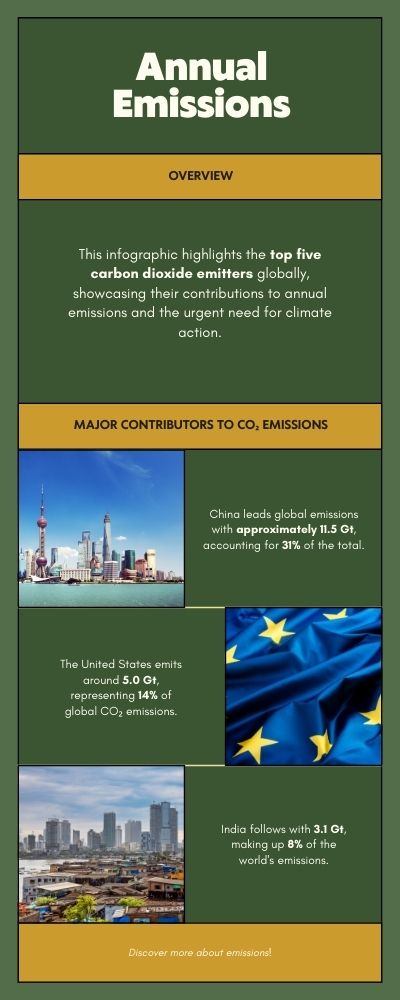
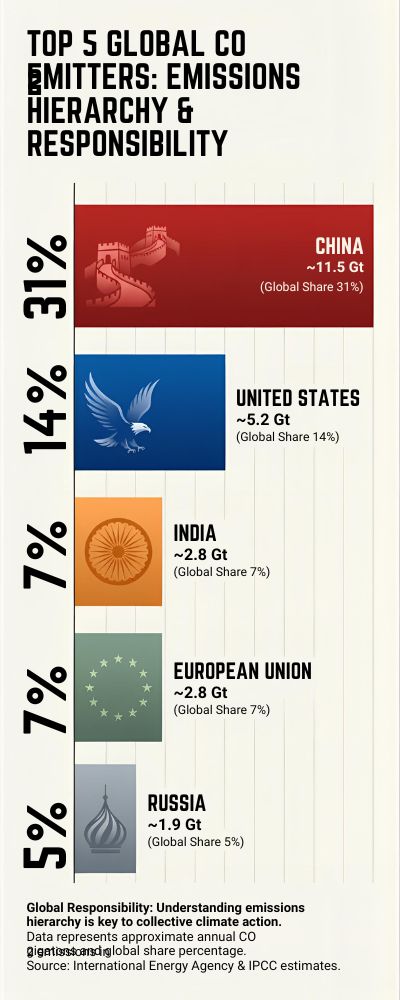
The who’s-to-blame-for-climate-change question isn’t always easy to ask, but with the data in the public domain, it’s relatively straightforward. A few big countries dominate the list of top emitters. The reasons aren’t sinister; rather, they have big populations, big economies and big energy consumption. Based on research from the Global Carbon Project and the International Energy Agency, here are the five countries that produce over half the world’s carbon dioxide emissions, in order.
| Rank | Country / Region | Annual CO₂ Emissions (Gt) | Share of Global Total |
| 1 | China | ~11.5 | ~31% |
| 2 | United States | ~5.0 | ~14% |
| 3 | India | ~3.1 | ~8% |
| 4 | European Union | ~2.8 | ~7% |
| 5 | Russia | ~1.9 | ~5% |
- China: The World’s Largest Emitter China is way out in front. The country alone is responsible for a third of global carbon dioxide emissions. Mostly, that’s because it’s the factory of the world. Factories, steel and cement plants, power plants to supply electricity, and all that comes with building and running a big industrial machine make China the world’s biggest CO2 emitter. According to the IEA Global Energy Review, China’s carbon dioxide emissions reached 11 billion tons in recent years. But there’s more to the story: China is also leading the world in building new renewable energy projects, like solar panels and wind turbines. This creates a kind of climate paradox, where the world’s dirtiest country is also building more clean energy than any other.
- The United States: High Emissions, High Energy Demand The U.S. is still the world’s second-largest carbon dioxide emitter, at about 5 billion tons per year, according to EPA global emissions data. One big reason is the lifestyle and infrastructure of the country: lots of driving, lots of air travel, lots of energy use. There are bright spots: U.S. carbon dioxide emissions declined slightly over the last decade as coal-fired power plants retired and the grid switched to cleaner sources of energy. Still, the U.S. is one of the world’s biggest emitters.
- India: Rapid Growth, Rising Emissions India is the world’s third-largest emitter, at around 3 billion tons per year, according to Our World in Data. The country’s economy is growing fast, and so are its carbon dioxide emissions, driven by industrial production, electricity demand and urbanization. But there’s an important caveat: India is still relatively clean on a per-capita basis compared with developed countries. The country’s per-person carbon footprint is far lower than many other places. That makes climate politics complicated. On one hand, India’s carbon dioxide emissions are increasing fast. On the other hand, millions of people there are still escaping poverty and will need access to energy.
- Europe: Europe is responsible for about 2.8 billion tons of carbon dioxide, collectively, according to European Commission climate reports. The EU has been reducing its carbon footprint over the last few decades, driven by a shift to renewable energy, carbon pricing and energy efficiency.
- Russia: Russia rounds out the top five at 1.9 billion tons per year, largely due to production of (and exporting) fossil fuels.
| Group | Share of Global CO₂ |
| Top 3 emitters | ~53% |
| Top 5 emitters | ~65% |
| Rest of the world | ~35% |
The Fastest-Growing Emitters: Nations Where Emissions Are Rising the Most
The countries with the highest carbon dioxide (CO2) emissions get most of the attention in discussions of climate change. China and the United States have the highest carbon emissions, and these countries are crucial to any global effort to curb climate change. But, there are other important countries to consider: those with the fastest growing carbon emissions. In this article, we will examine data from the Global Carbon Project and Our World in Data to explore the countries with the fastest growing carbon emissions since the mid-2010s and why that might be the case.
| Country | CO₂ Emissions Growth (2015–2023) |
| India | +30% |
| Indonesia | +20% |
| Vietnam | +40% |
| Philippines | +25% |
India and Southeast Asia
India is one of the most obvious countries with rapidly increasing carbon emissions. India is growing rapidly, and electricity demand is rising. India’s cities and infrastructure are growing, and millions of its citizens are joining the global middle class. According to Our World in Data, India’s CO2 emissions grew from 2.4 billion metric tons in 2015 to over 3.1 billion metric tons in recent years. Other countries in the region, such as Vietnam, have also seen rapid growth largely due to the growth of manufacturing.
The Middle East
The other region that has seen significant growth in carbon emissions has been the Middle East. While the situation here is a bit different than India and Southeast Asia, countries like Saudi Arabia and Iran have large oil reserves and economies that are largely dependent on the production of fossil fuels. As the populations of these countries continue to grow and as temperatures continue to rise, their energy demands continue to increase. The IEA World Energy Outlook notes that energy use in many Middle Eastern countries will continue to grow as their economies continue to diversify and as urban centers grow.
Africa
Africa is responsible for a small percentage of global carbon emissions, but the potential for growth is enormous. According to the UNEP Emissions Gap Report, Africa is responsible for less than 4% of global carbon emissions. However, electricity use on the continent could triple by 2040 as the population grows and as urban areas expand. Nigeria, Egypt, and South Africa are a few of the African countries that have already seen an uptick in emissions as they expand power generation. Hundreds of millions of Africans still lack reliable access to electricity, and this will need to change as the region develops.
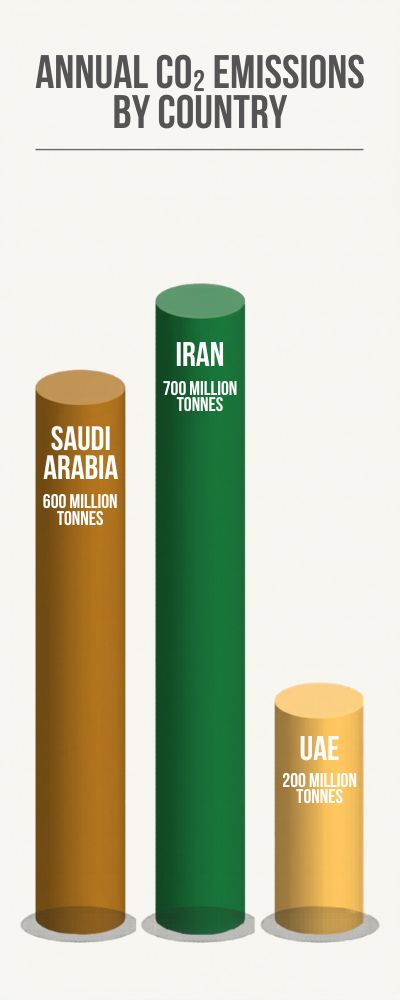
| Country | Annual CO₂ Emissions (Approx.) |
| Saudi Arabia | ~600 million tonnes |
| Iran | ~700 million tonnes |
| UAE | ~200 million tonnes |
Fast-Growing CO2 Emitters are a Critical Issue
Growth in carbon emissions in these countries and regions is often seen as a negative. But, the issue is not so simple. As an economy grows and develops, its energy demands often grow. The key is finding a way to meet increased energy demands without locking in decades of increased carbon emissions. This is one of the most important questions facing climate economists today, and solving this riddle is crucial to efforts to curb climate change. While it is a very difficult problem to solve, solving it is critical to mitigating climate change.
Sector Breakdown: Power, Transport, Industry, and Agriculture Emissions Compared
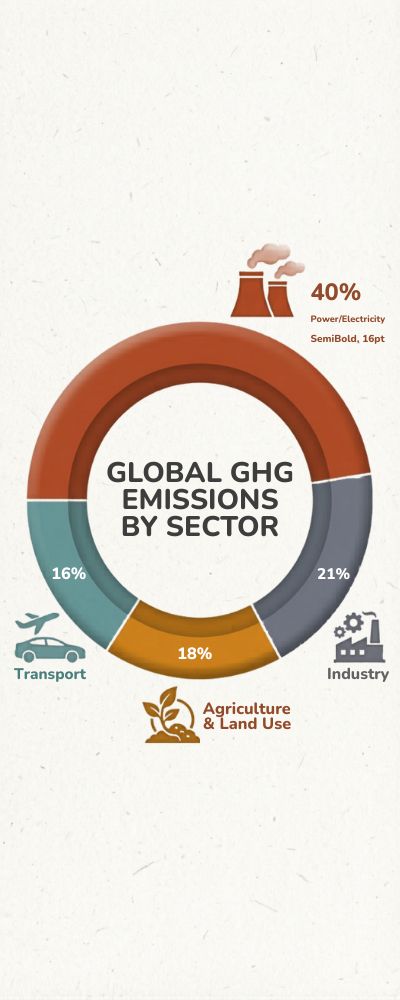
When we think about greenhouse gas emissions, smokestacks or tailpipes are what come to mind. That’s not entirely wrong, but it’s only part of the story. The four largest sources of global greenhouse gas emissions are the energy, transportation, industry, and agricultural sectors. Here’s a rough breakdown of each sector’s impact and how they contribute to the climate crisis:
According to the International Energy Agency (IEA) and the U.S. Environmental Protection Agency global emissions database, the energy sector, primarily in the form of electricity production, is the largest source of global greenhouse gas emissions. Electricity is used for nearly everything, from our homes and gadgets to factories and data centers. Much of the world’s electricity is still generated by burning fossil fuels, such as coal and natural gas. The IEA Global Energy Review estimates that electricity production generates between 14 and 15 billion metric tons of CO2 per year. Most of that comes from coal-fired power plants. However, there’s been an explosion of new solar panels and wind turbines in recent years. Despite the growth in electricity demand around the world, renewables are catching up. It’s a classic example of trying to drain a bathtub with the faucet still on.
| Sector | Share of Global GHG Emissions |
| Power / Electricity | ~40% |
| Industry | ~20–22% |
| Transport | ~16% |
| Agriculture & Land Use | ~18% |
Transportation, which includes everything from cars and trucks to airplanes and ships, is the second-biggest sector for greenhouse gas emissions. Vehicles are a ubiquitous part of daily life, and most of them run on gasoline or diesel. According to the Our World in Data transport emissions database, transportation accounts for around 8 billion metric tons of CO2 per year.
The industrial sector, which includes manufacturing and production of raw materials like steel and cement, is not always in the headlines. But it’s one of the biggest greenhouse gas emitters out there. Steel and cement are essential ingredients in building homes, roads, and other critical infrastructure, and producing them requires either super-high temperatures or chemical reactions that release greenhouse gases. The IEA Industrial Emissions Analysis found that heavy industry is responsible for more than 20 percent of global greenhouse gas emissions. Cement production alone accounts for 7 to 8 percent of global CO2 emissions, a statistic that still manages to shock many people. After all, concrete is the literal foundation of most cities around the world, and it has a carbon footprint to match.
Finally, there’s the agricultural sector, which doesn’t always receive the same level of scrutiny as the others. But it is nonetheless a significant source of greenhouse gas emissions. Farming activities like livestock, fertilizer use, rice production, as well as deforestation and other land-use changes, all result in potent greenhouse gases like methane and nitrous oxide. Though they have different global warming potentials than carbon dioxide, these gases still trap heat in the atmosphere. According to the Food and Agriculture Organization, agriculture and land use combined account for around 18 percent of global greenhouse gas emissions. Unfortunately, global food demand is only going to increase in the coming years, so emissions from agriculture aren’t going away anytime soon.
| Transport Type | Share of Transport Emissions |
| Passenger Cars | ~45% |
| Freight Trucks | ~30% |
| Aviation | ~11% |
| Shipping | ~10% |
So what’s the solution to all this? Looking at these numbers, it’s pretty clear that there isn’t a single bad actor to blame. Power generation, transportation, industry, and agriculture are all intertwined with the way modern society functions. It’s impossible to avoid generating emissions when flipping on a light switch, driving to work, or buying groceries at the store. The upshot of that is pretty straightforward: To reduce greenhouse gas emissions, we need to transform not just one sector, but all of them simultaneously. It’s not an easy task, but it is an interesting challenge for people who enjoy thinking about complex systems.
Carbon per Person: Which Countries Have the Highest Emissions per Capital?
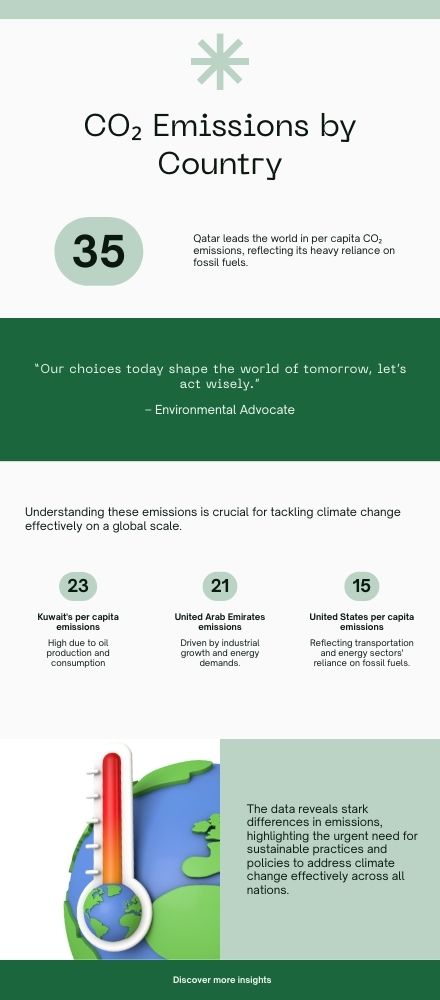
Carbon emissions per person. When people talk about climate change, they often talk about total emissions. Who’s dumping the most pollution into the atmosphere? But that doesn’t tell the whole story. Countries with really big populations will always produce more carbon, even if each person is producing less on average. To get around this, scientists often use a different metric: average carbon emissions per person. Essentially, it’s like splitting a restaurant bill. It’s easier to figure out who owes what. According to data from Our World in Data and the International Energy Agency, the countries with the highest per-capita carbon emissions aren’t always the biggest overall emitters. Some smaller countries that produce a lot of oil and gas rank near the top.
| Country | CO₂ Emissions per Person (Tonnes) |
| Qatar | ~35 t |
| Kuwait | ~23 t |
| United Arab Emirates | ~21 t |
| United States | ~14–15 t |
| Australia | ~15 t |
Top emitters per person
There are a few countries that always seem to rank near the top in terms of per-capita emissions. These tend to be places with energy-intensive industries, oil and gas exports, or super carbon-intensive lifestyles. Now, those are some big numbers! Qatar’s population is minuscule compared to China or India, but each person there is producing way more carbon. Why? Mainly because of the way they use energy.
Wealth, consumption, and energy use
Per-capita carbon emissions are closely tied to wealth and consumption patterns. Richer countries tend to consume more energy per capita, think big houses, lots of driving, air travel, and electricity use. For example, the average American produces around 14 or 15 tonnes of CO2 per year (according to U.S. EPA global emissions data). That’s way higher than the world average, which is more like four or five tonnes per capita. By contrast, per-capita carbon emissions tend to be much lower in poorer countries. This is one of the reasons climate politics can get so contentious. Some countries don’t think they should have to cut as much carbon, since their citizens are producing so much less. That’s a pretty understandable position, I think.
| Country | CO₂ per Person (Tonnes) |
| India | ~2 t |
| Indonesia | ~2.4 t |
| Nigeria | ~0.7 t |
| Ethiopia | ~0.2 t |
The lifestyle factor
Stop and think about it for a second. Heating and cooling your house, driving to work, flying on vacation, buying stuff that’s been shipped across the world, it all adds up! In many richer countries, this kind of lifestyle is just normal. No one thinks, hey, I’m going to produce several tonnes of carbon today! But we do, in aggregate. The IEA Global Energy Review frequently notes that consumption patterns in rich countries are one of the biggest drivers of per-capita carbon emissions.
Why per-capita matters
Measuring per-capita carbon emissions changes the emphasis a bit. Rather than placing blame on whole countries, it shows how important lifestyle and energy systems are. It kind of makes the problem feel more personal. When you look at those numbers, you can’t help but wonder: If the world average is around five tonnes per person, how can the high emitters ratchet down and get closer to that? No real answers to that question, unfortunately! But at least it’s worth asking.
The Methane Problem: Why This Gas Is Becoming a Bigger Climate Threat
When it comes to climate change, carbon dioxide tends to hog all the attention. And rightfully so, it’s the largest contributor to warming, after all. But methane shouldn’t be ignored. Methane has a shorter atmospheric lifespan than CO2, but during its lifetime, it is 28-34 times more effective at trapping heat than carbon dioxide, according to the Intergovernmental Panel on Climate Change. Over a 20-year time span, it’s around 80 times more effective. The latter is what tends to get scientists’ attention.
Methane emissions are on the rise
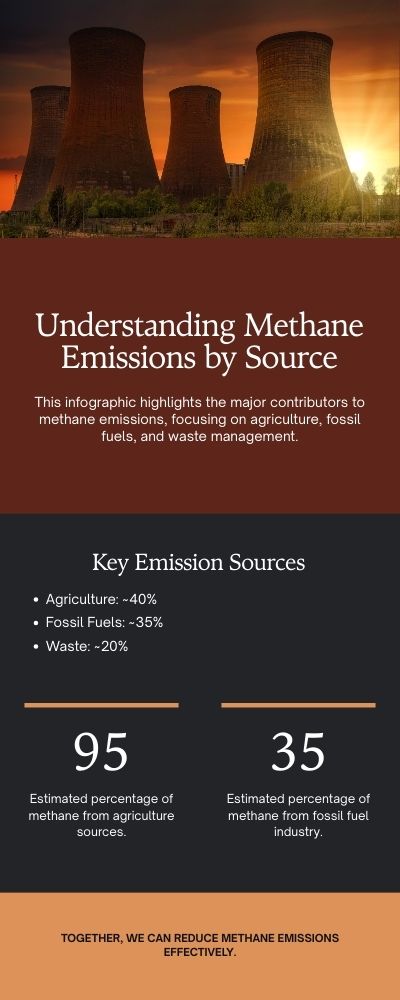
Despite the urgency, global methane emissions have actually been increasing for the last 10 years, according to the IEA Global Methane Tracker. The tracker estimates that in recent years, global methane emissions hit around 580 million tonnes per year, 60% of which comes from human activities. The biggest culprit is agriculture, with livestock digestive processes and rice paddies being among the largest emitters. (Yes, cow burps are actually a thing that concerns scientists.) The other major source of methane emissions is the fossil fuel industry. As oil and gas is extracted and transported, methane leaks out of pipelines, wells and storage tanks. Some of these leaks can’t be seen with the naked eye, making them difficult to measure. However, satellite technology has recently been able to detect massive leaks. According to the IEA Global Methane Tracker, the oil and gas industry emits around 120 million tonnes of methane every year. Many of these leaks are relatively easy to plug, but it requires monitoring, fixing seals and other repairs.
| Source | Estimated Share of Methane Emissions |
| Agriculture | ~40% |
| Fossil Fuel Industry | ~35% |
| Waste (landfills, sewage) | ~20% |
| Other sources | ~5% |
Why methane matters right now
Scientists are paying more and more attention to methane because of its short-term warming potential. As the NASA climate monitoring program notes, methane levels in the atmosphere have been rising rapidly over the past few years, reaching new highs of over 1900 parts per billion. Much of that increase came in the last two decades. Scientists are still trying to pinpoint the cause for the increase in methane after 2007. Suspects include a rise in agriculture and leaks from fossil fuel production.
| Indicator | Value |
| Global methane concentration | ~1900 ppb |
| Pre-industrial level | ~700 ppb |
| Increase since 1750 | ~160% |
A faster solution?
Even as methane remains in the shadows compared to CO2, it also offers a glimmer of hope. Cutting methane emissions could have a near-term impact on the climate. Because methane has such a short lifespan in the atmosphere, limiting emissions today could slow warming within a few decades. The UNEP Global Methane Assessment estimates that the world could prevent around 0.3°C of warming by 2050 by cutting methane emissions aggressively. It’s not a huge number, but in climate terms, it’s significant. And so while CO2 remains a long-term problem, methane is increasingly seen as a short-term opportunity, a gas that humans might be able to cut quickly, if governments and companies and farmers work together. Whether they will do so, however, remains to be seen.
The Green Energy Effect: How Renewables Are Changing Global Emissions
Over the past ten years, something fairly significant has been underway in the world of energy. Not the overnight, front-page kind of event. More of a, look around and notice it kind of thing. Solar panels on roofs. Wind turbines on hillsides and shores. Giant solar farms blanketing deserts. You turn around and say, wait a minute… how did this happen? Renewable energy has grown much faster than many models predicted fifteen years ago. According to the IEA Renewables Market Report, about 90% of the new electricity generating capacity that’s come online in the past few years has been from renewables. That’s not a one-off shift. That’s a structural change in the way electricity is generated.
Solar Went From Expensive to Ridiculously Cheap
Back in around 2010, solar power was still pretty pricey. It required heavy government subsidies. Some people even called it unfeasible. Fast forward to today and the narrative flipped. Solar electricity costs have plummeted over 80% since 2010, according to data from the International Renewable Energy Agency. The cost of wind power has also declined significantly.
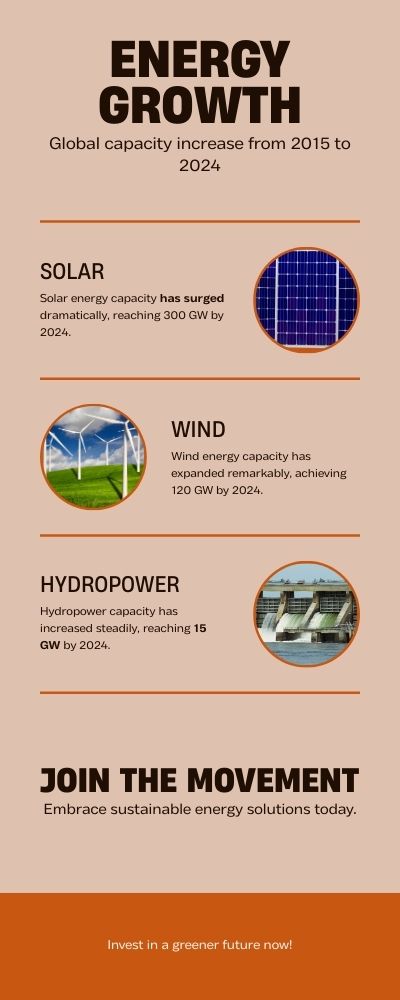
| Energy Source | Global Capacity Growth (2015–2024) |
| Solar | +300% |
| Wind | +120% |
| Hydropower | +15% |
Renewables Are Actually Cutting Emissions
So what has all this new clean energy done to emissions? Well, it’s helped. A lot, actually. Renewable electricity has already avoided around 2 billion tonnes of carbon dioxide emissions per year, according to the IEA Global Energy Review. That’s roughly equivalent to the annual emissions of several large industrial economies combined.
The Catch Nobody Likes to Talk About
Here’s the thing. Even though renewable energy is growing fast, energy demand keeps growing too. Population growth. Electric cars. Data centers. Air conditioning. New industries. Our modern way of life is highly energy-intensive. According to the IEA World Energy Outlook, electricity demand has been increasing by around 2 to 3% per year, globally. So sometimes renewables aren’t directly replacing fossil fuels. Instead, they’re meeting new demand while fossil fuels handle the rest of the load. Think of it like renovating a house with people still living in it. You can’t exactly shut down the lights.
| Energy Source | Share of Global Electricity |
| Coal | ~35% |
| Natural Gas | ~23% |
| Renewables (solar, wind, hydro) | ~30% |
| Nuclear | ~9% |
Still, Something Important Is Changing
Despite all those caveats, the general trend is pretty clear. Wind and solar are now the largest source of new electricity generation worldwide. Coal plants are slowly disappearing in some areas. Electric vehicles are slowly entering the transportation sector. Batteries are improving. None of this solves the climate crisis overnight. If someone promises you that, they’re probably trying to sell you something. But the energy system is changing. Real, measurable progress is happening. And if renewables continue to grow at the rate we’ve seen over the past decade, the next ten years could bring global emissions reductions that would’ve sounded implausible not so long ago. Frankly, it’s one of the only climate trends that leaves you feeling cautiously optimistic.
The Cost of Carbon: Economic Damage Linked to Rising Greenhouse Gases
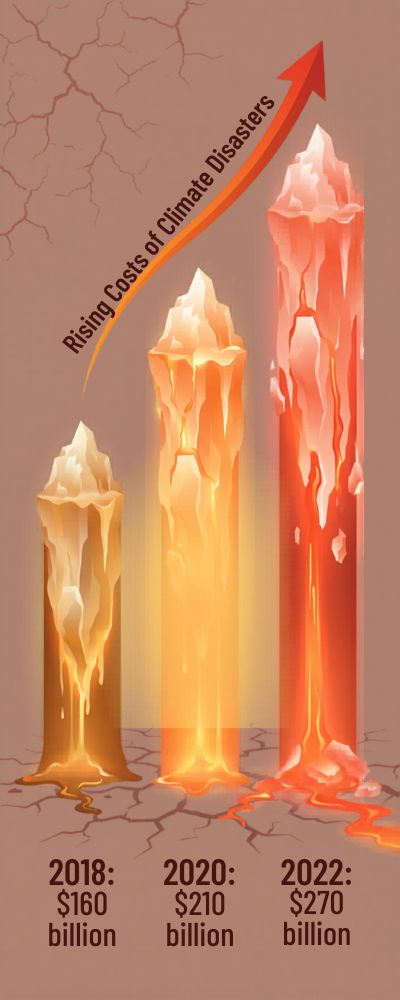
Most people, when asked to think of climate change, imagine melting ice or polar bears on icebergs. This is fair enough, but there’s one other aspect of climate change we don’t hear about so much: money. Billions of dollars. Maybe even trillions. The greenhouse gasses are not just heating up the planet, they’re also steadily pouring dollars out of bank accounts, insurance coffers, and government treasuries. Take a moment to think about it. The thing about hurricanes, wildfires, and droughts is that someone always has to pay the damages. Often, many someones have to pay. According to the NOAA Billion-Dollar Weather and Climate Disasters database, the US alone incurred $165 billion in climate-related disaster losses in 2022 alone. Take that figure, then extrapolate it out to the rest of the world.
Extreme Weather Is Getting Expensive
A few decades ago, hurricanes, wildfires, and floods were rare enough that they made the news. These days, they’re almost seasonal. Aon’s Global Weather Disaster Report puts the total damage cost of climate-related disasters worldwide at around $270 billion in 2022 alone.
| Year | Estimated Global Climate Disaster Cost |
| 2018 | ~$160 billion |
| 2020 | ~$210 billion |
| 2022 | ~$270 billion |
Food Systems Are Feeling the Pressure
Climate costs also show up in less obvious places, like agriculture. Farmers are always the first to feel climate impacts, changes in rainfall, heatwaves, and so on all impact crops. Corn, wheat, rice, and other staples all have their limits. The Food and Agriculture Organization suggests that climate stress may reduce agricultural productivity by up to 30% in some areas by 2050. But that’s not going to just hurt farmers, it will have knock-on effects. Food prices will rise, supply chains will get a little tighter, and your grocery bill will go up. Anyone who has looked at a grocery receipt in the past year has probably suspected as much.
The “Social Cost of Carbon”
Economists have attempted to quantify the damage done by climate change into something we can better understand: money. This is known as the Social Cost of Carbon. It’s the estimated amount of economic damage done by emitting a single extra tonne of CO2 into the atmosphere. According to the most recent estimates (courtesy of the U.S. Environmental Protection Agency), every tonne of carbon works out to around $190 worth of damage, once you factor in long-term climate impacts.
| Metric | Estimated Value |
| Social Cost of Carbon | ~$190 per tonne |
| Global CO₂ emissions | ~37 billion tonnes/year |
| Estimated global climate damage potential | Trillions annually |
The Real Debate Isn’t Whether It Costs Money
One last thing. A lot of the debate around climate change is around the cost of addressing the problem. Renewables, infrastructure, policy, they all cost money. But many economists point out that the real question is: what’s the cost of doing nothing? The International Monetary Fund warns that unchecked climate change could shave significant growth off the global economy over the coming decades. In other words, it might be a choice between paying now and paying later. If past experience is anything to go by, it won’t get any cheaper.
Climate Targets vs Reality: Are Countries on Track for Net-Zero?
You might have noticed that “net-zero” has been getting tossed around a lot in climate conversations the last few years. World leaders declare it at summits. Companies tout it in their reports. Politicians include it in speeches. The concept is straightforward: We just need to offset the greenhouse gases we release into the atmosphere by absorbing the same amount. Easy peasy, right? But when you actually examine the math, things get a little more, well, interesting.
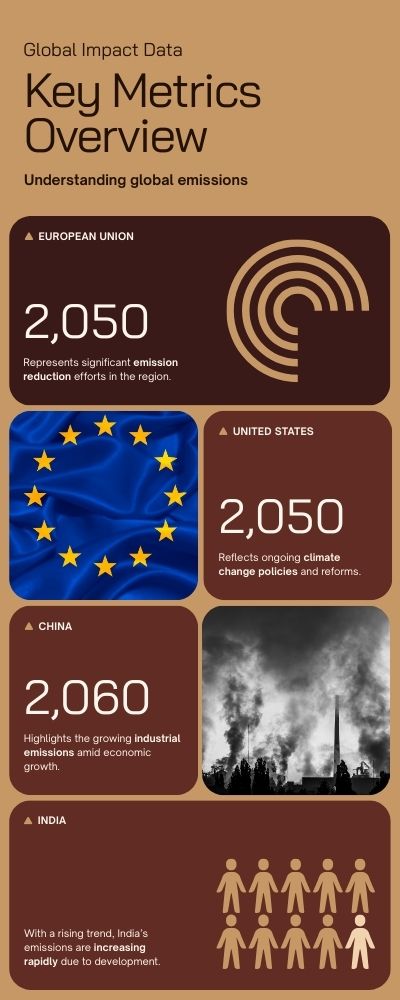
Countries that account for more than 90% of global GDP have already committed to some form of a net-zero target, mostly for 2050 or 2060, according to the United Nations Net-Zero Coalition. That seems like a good start, at least on paper. The problem is whether those commitments are actually reflected in current trends. There’s a thing in climate science called the “emissions gap.” Essentially, it’s the gulf between what countries commit to do and what their actual policies are achieving. And it’s still pretty big. The UNEP Emissions Gap Report found that current national policies would likely leave us at 2.5 to 2.9°C of warming by 2100. That’s a long way from the 1.5°C goal established by the Paris Agreement.
| Country / Region | Net-Zero Target Year |
| European Union | 2050 |
| United States | 2050 |
| China | 2060 |
| Japan | 2050 |
| India | 2070 |
So, why aren’t we moving faster?
Energy systems are huge and deeply ingrained in economies. You can’t just magic away coal-fired power plants, pipelines, factories, and cars overnight. According to the IEA World Energy Outlook, global fossil fuel demand has peaked in some areas, but overall emissions are still near record highs of around 37 billion tonnes of CO2 per year. It’s a bit like turning a tanker, as even after you shift the rudder, it takes a while to change course. Politics is another factor. Climate action has to compete with other priorities like economic growth, energy security, and public opinion.
Not all is lost, though. Some countries are making tangible gains. The European Union has already cut its emissions by about 30% since 1990, according to the European Commission climate strategy. That’s been driven largely by a surge in renewables and energy efficiency. Electric cars, solar, and batteries are also improving faster than a lot of people predicted, which could accelerate the energy transition. Progress isn’t uniform, but it’s real.
| Scenario | Projected Global Warming |
| Current policies | ~2.5–2.9°C |
| Stated pledges | ~2.1–2.4°C |
| Paris Agreement goal | 1.5°C |
Are We Actually Making Progress Toward Net-Zero?
Well, that’s the $64,000 question. If you just look at countries’ pledges, then the long-term trends are in the direction of net-zero. But if you look at actual policies and current emissions, the world is still not fully on a net-zero trajectory. In other words, we know where we want to end up, but we’re not entirely sure how we’ll get there yet. Some days it feels like we’re making agonizingly slow progress. Other days you see some breakthrough, such as a new technology, a new policy, or an unexpected move in energy markets, and you wonder if maybe this energy transition is really gathering steam. Either way, the clock is ticking. And we’ll probably have a much better sense over the next decade if all those net-zero pledges will actually become a reality or just remain a pipe dream on a piece of paper.
The Climate Tipping Point Debate: What the Latest Data Says
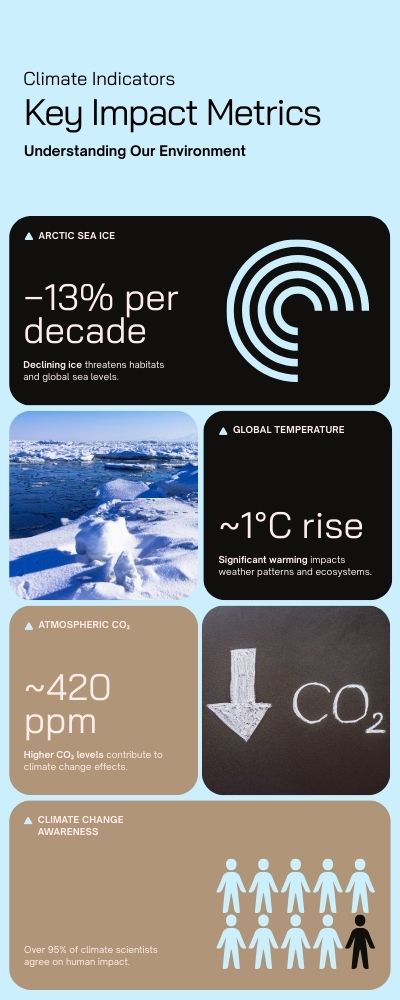
‘Climate tipping point’ is a term that sounds a bit sensationalistic, but to be fair, it is a bit sensationalistic. In a nutshell, a climate tipping point is a level of warming that once crossed, will lead to large and often irreversible changes in the Earth’s systems. Think of it like pushing a glass of water towards the edge of a table. Initially, it doesn’t do much, but once you reach a certain point, it falls off and you can’t put the glass back together again. Scientists worry that some of the Earth’s natural systems (like ice sheets, forests, and ocean circulation patterns) might behave the same way once warming reaches certain levels. According to the IPCC AR6 report, several tipping elements could be triggered between 1.5°C and 2°C of warming. If that temperature range seems familiar, it’s because that’s where we’re likely headed if we don’t change anything.
Systems Scientists Are Watching Closely
There are many parts of the Earth system that could potentially exhibit tipping behavior. It’s not a guarantee that any of these will collapse tomorrow, but they are important to monitor because they have big consequences.
| Climate System | Potential Impact |
| Greenland Ice Sheet | Major sea-level rise |
| Amazon Rainforest | Forest dieback and carbon release |
| Arctic Sea Ice | Faster regional warming |
| Atlantic Ocean Circulation (AMOC) | Disruption of global climate patterns |
What the Latest Data Suggests
A lot of recent research has reinvigorated the debate, because we’re starting to see some warning signs. For example, according to satellite data from the NASA Arctic Monitoring Program, Arctic sea ice has been declining at a rate of around 13% per decade since 1979.
Why the Debate Is So Complicated
One of the big challenges with predicting climate tipping points is that it’s not easy. Climate is a massive system that involves oceans and forests and ice sheets and atmospheric chemistry and basically everything else. These systems interact with each other in complex ways that sometimes surprise even the scientists. Some scientists are concerned that we’re underestimating the risk of tipping points. Others are worried that we’re counting our chickens before they hatch, and assuming abrupt changes will happen sooner rather than later. According to the UNEP Emissions Gap Report, while the risk of tipping points does increase with temperature, we don’t actually know what the exact tipping levels are. In other words, the science is still evolving.
A Conversation That’s Still Unfolding
If you ask climate scientists about this stuff, you’ll hear a range of views from cautious to concerned. Not panicked, necessarily, but urgent. The debate around tipping points isn’t about assigning an exact date to when some big catastrophic event will occur. It’s a reminder that the Earth’s climate system does have limits. And the closer we get to 1.5 to 2°C of warming, the more relevant those limits become. Personally, I find the tipping point debate both fascinating and terrifying at the same time. Fascinating because Earth systems are so complex, and terrifying because we’re basically running an experiment on the only planet we have. Which means, whether we like it or not, the choices we make over the next couple of decades will determine the course of the climate for the next several centuries.
What the Next Decade Could Look Like: Emission Projections to 2035
Predicting the future of global emissions is a bit like predicting the weather a month out. We can see the trends but there’s always a bit of uncertainty hanging around. Despite this, climate scientists and energy analysts do a lot of work to try and project where things might go. Right now, global CO2 emissions are around 37 billion tonnes per year (according to the Global Carbon Project). The question is what they do next. Do they start falling away steadily, or do they ‘plateau’ for a while before declining? The answer, frustratingly, is that it depends on what happens in energy markets, policy and technology in the next few years.
The “Current Policies” Scenario
If countries broadly follow the policies that are already in place, then emissions are likely to plateau and then fall gently over the next decade. The most recent World Energy Outlook by the IEA suggests that global emissions will remain near current levels until the late 2020s before slowly declining.
| Year | Projected Global CO₂ Emissions |
| 2025 | ~37 Gt |
| 2030 | ~36 Gt |
| 2035 | ~34–35 Gt |
A Faster Transition Scenario
Now consider an alternate scenario. Policy supports faster deployment of renewables, new car sales start to shift toward electric vehicles, and energy productivity improves more quickly. With more ambitious policy, emissions could fall more sharply. The UNEP Emissions Gap Report finds that global GHG emissions need to fall to around 43% below 2019 levels by 2030 in order to put the world on track for 1.5°C.
Technology Is Moving Faster Than Expected
One of the problems with projections is that it’s hard to predict technology. Sometimes it moves faster than expected. Take solar for example. Many projections 10-15 years ago underestimated how fast the cost of solar would fall. It’s now one of the cheapest sources of electricity in many regions. Electric vehicles might be another example. The latest Global EV Outlook by the IEA suggests that, with supportive policy, EVs could account for over 40% of new car sales worldwide by 2030. If that happens, then oil demand from transport could begin to decline more quickly than many expect.
| Scenario | Emissions by 2035 |
| Current policies | ~34–35 Gt |
| Strong climate action | ~25–28 Gt |
The Next Decade Is Pivotal
You often hear climate researchers say that “the 2020s are decisive”. By 2035, global emissions don’t need to be zero, but they do need to be trending clearly downward if we’re going to meet longer term climate goals. The 2020s will tell us whether the global energy transition accelerates or whether emissions remain stubbornly high. The thing that makes this period feel odd is the uncertainty. Technology to reduce emissions is improving more quickly than expected. But global energy demand keeps rising. Two huge forces, pulling in opposite directions. Which one will dominate? Well… we’re about to find out.
Sources
Below is a consolidated list of the data sources referenced throughout the article “Global Emissions and Greenhouse Effect Statistics (2020–2026)”. All sources are presented in a consistent citation style.
International Energy Agency (IEA). Global Energy Review 2021.
https://www.iea.org/reports/global-energy-review-2021International Energy Agency (IEA). Global Energy Review – CO₂ Emissions in 2021.
https://www.iea.org/reports/global-energy-review-co2-emissions-in-2021International Energy Agency (IEA). Global Energy Review 2023.
https://www.iea.org/reports/global-energy-review-2023International Energy Agency (IEA). Renewables Market Report 2024.
https://www.iea.org/reports/renewables-2024International Energy Agency (IEA). World Energy Outlook 2023.
https://www.iea.org/reports/world-energy-outlook-2023International Energy Agency (IEA). Global Methane Tracker 2024.
https://www.iea.org/reports/global-methane-tracker-2024International Energy Agency (IEA). Global EV Outlook 2024.
https://www.iea.org/reports/global-ev-outlook-2024Global Carbon Project. Global Carbon Budget.
https://www.globalcarbonproject.org/carbonbudgetUnited Nations Environment Programme (UNEP). Emissions Gap Report 2024.
https://www.unep.org/resources/emissions-gap-report-2024Our World in Data. CO₂ and Greenhouse Gas Emissions Data.
https://ourworldindata.org/co2-emissionsOur World in Data. Global Electricity Mix.
https://ourworldindata.org/electricity-mixU.S. Environmental Protection Agency (EPA). Global Greenhouse Gas Emissions Data.
https://www.epa.gov/ghgemissions/global-greenhouse-gas-emissions-dataU.S. Environmental Protection Agency (EPA). The Social Cost of Carbon.
https://www.epa.gov/climatechange/social-cost-carbonNASA Climate Change. Climate Vital Signs: Arctic Sea Ice.
https://climate.nasa.gov/vital-signs/arctic-sea-iceNASA Climate Change. Ice Sheet Monitoring Data.
https://climate.nasa.gov/vital-signs/ice-sheetsNational Oceanic and Atmospheric Administration (NOAA). Climate Monitoring Data.
https://www.noaa.govFood and Agriculture Organization (FAO). Climate Change and Agriculture Resources.
https://www.fao.org/climate-change/resources/en/International Renewable Energy Agency (IRENA). Renewable Capacity Statistics.
https://www.irena.org/publicationsUnited Nations. Net-Zero Coalition Information.
https://www.un.org/en/climatechange/net-zero-coalitionClimate Action Tracker. Global Climate Target Analysis.
https://climateactiontracker.orgNature Climate Change. Temporary Reduction in Global CO₂ Emissions During COVID-19.
https://www.nature.com/articles/s41558-020-0797-xNature. Climate Tipping Points Research.
https://www.nature.com/articles/s41586-019-1256-6Aon. Global Weather, Climate and Catastrophe Insight Report.
https://www.aon.com/weather-climate-catastrophe-insightWorld Bank. Climate Change and Development.
https://www.worldbank.org/en/topic/climatechangeInternational Air Transport Association (IATA). Air Passenger Demand Reports.
https://www.iata.org/en/pressroom