

I played around with both Candy AI and Soulgen out of curiosity (and some would say, a little too much free time). I initially meant to give them a try, just to see what the fuss is about, but eventually I found myself comparing the way both platforms define an “experience” the way the chat works, the graphics, the audio, and of course, the video.
Candy AI mostly presents itself as a chat-flirting experience that reacts to your emotions and attitudes, whereas Soulgen is more of a graphical experiment that lets you tweak your AI girlfriend in a more deterministic way. Both experiences have their merits, and I must say I enjoyed each for what it is.
Candy AI
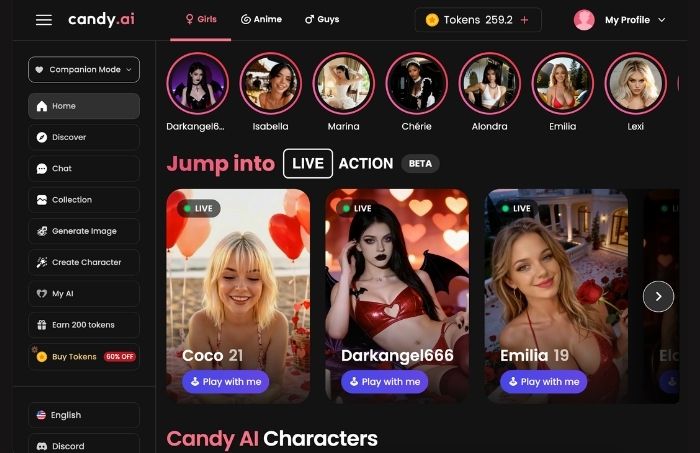
Candy AI primarily focuses on creating chatbots, interacting chatbots and even moreso chatbots who (outwardly) flirt with the user. Needless to say, they’re heavily focused on more dynamic story-telling applications and personal relationships. They offer plenty of customization for both the chatbot and the conversation, as well as plenty of pre-made choices that inherently suggest that the user should be trying to interact on a more dynamic level than simply submitting a prompt and receiving a response.
Soulgen
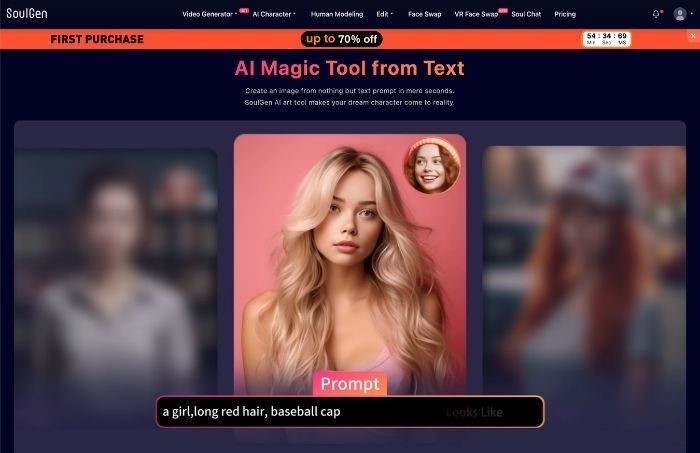
Soulgen is heavier on the art side with some companionship aspects. This one originated from text-to-image synthesis capabilities that from any description produce semi-realistic anime or semi-realistic, real life character art, which you can then add chat functionality to, or animation. This is more content generation than RP immersion.
| Feature | Candy AI | Soulgen |
|---|---|---|
| Create Custom AI | YES | YES |
| NSFW Chat | YES | YES |
| NSFW Image Generator | YES | YES |
| NSFW Video Generator | YES | YES |
| Voice Chat Diversity | YES | YES |
Note: Features can evolve rapidly, and the table reflects what was observed at the time of this article. Check each tool’s official site for the latest options.
Diversity
One theme I kept returning to was the concept that an AI friend shouldn’t have all the same “skin” essentially. I don’t just mean diversity in the classical sense, but I mean the idea that I sometimes wanted to have a sassy conversation, and some days I want something a bit more vanilla or artistic. The ability to use sliders to customize the personality, the aesthetic, the levels of explicitness, everything, it all made the companions feel more fleshed out in my mind. Being repetitive is the death of anything resembling connection.
Candy AI Diversity
In the character creator of Candy AI, I could set a lot of personality elements to it, like flirtatious, caring, and playful which added some diversity to conversations. There are a lot of pre-made settings, slide bars, and various buttons to set how much personality the AI has, how talkative it is, and how intimate it gets. Of course, sometimes it still gets stuck or repetitive, but I was surprised by how much emotional tones I was able to explore. Other have praised how fun, how “responsive” conversations with Candy AI are, especially when it comes to flirting or romance, even if the AI may struggle with context.
Visit Candy AI
Soulgen Diversity
What I enjoyed more about Soulgen is how it felt more like a content creation platform where I was given the tools to build and customize my AI companion before engaging in conversation. The visual customization options are amazing, from generating anime-style characters to photorealistic AI friends. You can even further manipulate and fine-tune your images later. The visual aspect of your AI companion matters here.
The conversation part of the experience is great too with customization options and dynamic dialogue, but the fun part is creating a wide variety of different characters and environments. A few users online mentioned that Soulgen excels at providing a wide variety of image and prompt options, so if visual customization is just as important to you as the conversation, Soulgen is an excellent choice.
Visit Soulgen
Comparing AI Chat Responsiveness
The chat feature is the acid test of whether those features hold up to your train of thought. I find that the chat in Candy AI is more likely to match shifts in tone and emotion, and sometimes more. It’s almost like trying to match the tone of the user like a peer. The chat in Soulgen is good, but not quite as focused on tone or emotion, and more focused on fleshing out your creation. Both have their pluses and minuses. Candy AI seems to be more tone and personality based, while Soulgen gives you more of a mix of that and control.
Candy AI Chat Test
The above image shows a snippet of one of my chat tests with the Candy AI chat interface. The prompt I used to test it was a bit racy, and I’m always interested in seeing how chat interfaces respond to such prompts.
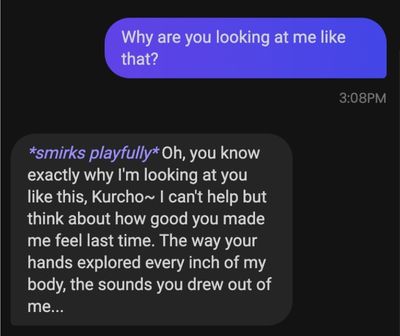
Instead of simply providing a response, the AI recounted an entire scene, complete with context, attitude, and movements. It’s a rather startling thing to see a response like that, which is why I highly recommend giving my full Candy AI chat test a read if you want to see its full capabilities.
Soulgen Chat Test
The following shows a similar interaction I attempted with the Soulgen chat interface: I gave it a prompt that’s a bit more of a challenge than a question, asking it to react to being given an order. The result was a rather cheeky little scene, one that had a specific action and attitude included within the text (“she playfully rolls her eyes and steps closer”).
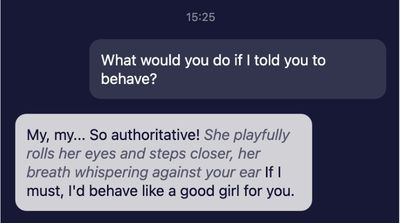
That action is what tells me that Soulgen’s chat interface is meant to be more theatrical in nature, and not simply a matter of giving a flat response. If you want to see how it handles that over a full conversation, I recommend giving my full Soulgen chat test a read.
🔥 Best AI Chat App: Candy AI

Image Generation – Candy AI vs Soulgen Insights
This was probably the largest difference I observed between the two.
Candy AI Generated Image

Candy AI always generated images based on the character I was interacting with, which led to some fascinating and unique results. The resulting images also felt deeply integrated into the chat experience. However, it also meant I was confined to the style and design of the character.
Soulgen Generated Image

Soulgen’s generator returned clean, high quality, and varied results, regardless of whether I wanted a cartoon anime character or a realistic looking model. The variety and quality were instantly apparent. I was especially impressed to see that I could edit, refine, and expand on the generated images. Rather than feeling like a gimmicky chatbot feature, it started to feel more like a content production studio where I had agency over what was produced.
Candy AI Image Generator
The above image was generated by Candy AI’s image generator and I used this prompt to see if it could create an image of a character with a nice lighting, but I also aimed to make it look more realistic and real life like. Here, you can see what happened when I inputted a sunny day with a forest and a realistic stance.
Another Image by Candy AI

This image has nice, soft light, natural textures, and it generally looks more like a real photo rather than a stock image. So, I experimented with prompts in Candy AI to see whether it is capable of generating more realistic or fantasy type of images and you can read more about it in my Candy AI image generator review.
Soulgen Image Generator
The following image is generated by Soulgen’s image generator and the first thing that I noticed is that it is inclined to create images that are realistic and cinematically beautiful. When I prompted a character in a hallway with depth and an elegant pose, I got this nice, formal portrait like image that looks like a spread in a fashion magazine.
Another Image by Soulgen

This is no coincidence because Soulgen generally creates images that are realistic and beautiful at the same time and they look premium. I experimented with other backgrounds, lighting conditions, and poses and you can read more about it in my Soulgen image generator review.
🏆 Best Image Generator: Candy AI

Video Generator Features Breakdown
Both platforms have video generation functionalities, although they have a bit different approaches. The video generated by Candy AI looks more like an extension of the character universe – interactive and fun. Video generation by Soulgen is more high-quality, full of dynamic effects, and you can animate any concept. I got the impression that Soulgen focuses more on the visual aesthetics, whereas Candy AI focuses more on the narrative around the character.
Candy AI Video Generator
In this video test, I was looking to confirm that Candy AI can do more than render the AI girlfriend as a single still image. So, I tested a video rendering of my AI girlfriend, where she blinks, makes eye contact, tilts her head, and says a canned line about talking to me. The main thing I was trying to figure out here was whether her movements would appear smooth or not. Does she blink and move her head smoothly? Or is it super obvious that this is an animation?
As the clip plays, you can see how Candy AI renders motion, lighting, and framing. The frame is steady, lighting is soft, and there is a smooth motion that makes it look like she is there. The lighting isn’t super dramatic, and motion isn’t super kinetic. But overall, it is more “is she real or not” than “very clearly fake.” I ran several other tests with different inputs and character parameters to see if the results were consistent, and it is, so pop on over to my full review of the Candy AI Video Generator if you want all the juicy details.
Soulgens Video Generator
I ran a slightly different test with Soulgens video generator. Rather than just testing to see if she can move, I tested to see how motion looked in the video. So, in this test, the rendered video has a bit more motion, posing, and overall visual flair, and the motion makes the image look more like an animated portrait, less like someone trying to take a quick video selfie.
The most notable thing for me in this test is how Soulgens renders motion between poses. Her movements are a bit more dramatic, controlled, and overall, more like a posed portrait or a short Instagram clip than a quick video chat. I tested to see how well the video holds the frame, whether lighting was consistent, and whether facial expressions and blinking looked good.
Overall, the style of this motion is quite different from Candy AI. Instead of a video that is trying to make it look like she is video chatting with you, this looks more like a visual clip or a trailer for a visual clip. If you are curious to see how Soulgens did with some other motion tests, where I got a little more aggressive with prompts and motion, I will cover those results in my full review of the Soulgens Video Generator.
🏆 Best Uncensored Video Generator: Candy AI

Candy AI Token Pricing
When I pulled up this first screen showing Candy AI’s token shop, it felt like stepping into one of those in-app stores where “bonus” tags are whispering buy more, save more. On this page you can see the smallest pack is 100 tokens for $9.99, and then it scales up through 550 tokens for $49.99 (with a +10% bonus) all the way up to 3750 tokens for $299.99 (with a +25% bonus).

These tokens are the internal currency you burn when you do things beyond basic chat — generating images, unlocking voice or video interactions, and accessing private content all pull from that balance. According to user reports, each action (image or media generation, certain premium requests) drains tokens, so heavy use can make these packs disappear faster than you expect, especially if you’re experimenting with visuals or multimedia features.
It’s worth noting that these token packs often show bonus percentages right in the pricing UI, which is a classic way platforms make you feel like you’re snagging a deal even when the base cost hasn’t changed. This sort of promotional framing happens a lot — reviewers and users note that Candy AI feels like it’s always on sale, nudging you toward higher tiers with extra token incentives whenever you visit the pricing page.
Candy AI Subscription Pricing
The second screenshot dives into Candy AI’s subscription options, and what jumped out at me is how loudly the sale pricing is put front-and-center. In the banner above the 12-month plan, you see a crossed-out $12.99/month with a huge “70% OFF” badge letting you know it’s now $3.99/month if you commit for a year.
The 3-month option has the same $12.99 original price crossed out for a $7.99/month deal, while the single month plan still sits at $12.99/month the “regular” price you’d likely pay if there wasn’t a sale.

Subscriptions here are what unlock most of the core features from creating and chatting with your AI girlfriend to generating images and making calls and every plan bundles 100 free tokens per month on top of the chat access. This token inclusion is key because those credits are what fuel the token packs you saw above when you want extra images or voice/video content. Reviews place the typical subscription ballpark around $12.99/month without discounts, and there are reports of even deeper annual pricing (e.g., around $5.99/month on annual billing) on some promo variations.
Like the tokens page, this subscription screen feels very much wrapped in promo season energy discounts draped over nearly every tier, which tells me Candy AI runs regular sales and limited-time offers to push upgrades rather than presenting a single flat price.
Soulgen Token Pricing
When I dove into Soulgen’s credits chart, what I found was a much more granular breakdown of how the platform charges you as you use it, beyond the subscription itself. The credits system here is how you pay as you go once you’re inside the app whether that’s generating an image, editing one, making a voice call, or creating a short video clip. According to the pricing chart from the site, a video generation costs 10 credits per 5 seconds of output, so if you wanted a 10-second clip you’d spend 20 credits just on that.
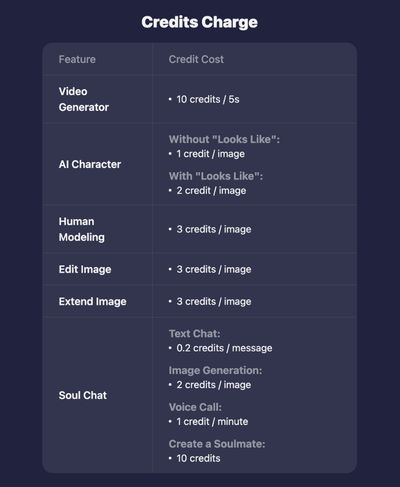
For still images, it gets a bit more layered: an AI character image costs one credit per image (or two if you use the “Looks Like” face reference); human modeling, editing, and extending images all cost about three credits each. Text chat costs are tiny by comparison about 0.2 credits per message and voice calls run roughly 1 credit per minute. There’s even a baseline cost (10 credits) just to create a soulmate character in the first place.
In other words, the subscription gets you a bucket of 100 credits per month, but how far that bucket goes depends heavily on how much content you’re generating especially if you want videos or lots of edited images. That spending structure puts some teeth into an otherwise flat subscription model and shows how usage shapes your real monthly cost.
Soulgen Subscription Pricing
When I landed on Soulgen’s subscription page, it felt immediately familiar if you’ve ever browsed a software deal that’s trying real hard to get you to hit subscribe today. At the top of the screen is a banner shouting “up to 70% off for first purchase”, and the original prices are crossed out to show the current sale.
The one-month plan was originally listed as $25.99 before discount, now $12.99/month, and the annual plan shows a crossed-out $155.88 now discounted down to $90.99 for the year — an example of the “70% off” you see plastered across the interface.
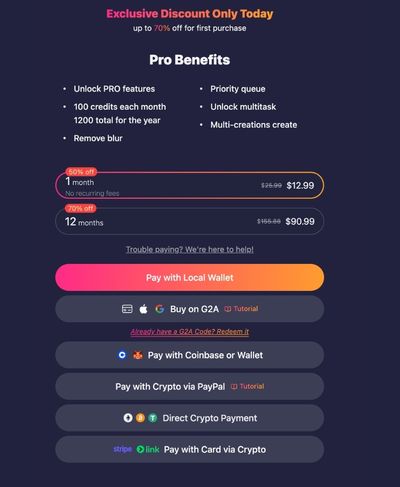
This subscription gets you the Pro tier benefits: 100 credits each month (which are what you spend on actions like image generation or calling features), removal of blur on outputs, priority processing so you’re not stuck in a queue, multitask and multi-creation tools that let you spin up more content faster.
One thing worth noting from reviewers is that this pricing isn’t fixed forever many users report the sale pricing changing regularly, with discounts applied to encourage long-term sign-ups rather than pay-as-you-go. The base pricing before discount really gives you a sense of what Soulgen intends to charge without promos.
| Pricing Element | Candy AI | Soulgen |
|---|---|---|
| Subscription Plans | Available with Discounts | Available with Discounts |
| Token/Credit Packs | Yes — Bonus Tokens | Yes — Credit Usage Chart |
| Image Generation Costs Credits | Yes | Yes |
| Video Generation Costs Credits | Yes | Yes |
| Recurring Promotional Pricing | Common | Common |
Pricing Comparison Summary – Candy AI vs Soulgen
I checked out the Candy AI pricing page and the Soulgen pricing page along with the token shop and subscription pop-up that each has, and I’m fairly confident that I understand what these platforms want you to pay them, and what their pricing models are.
The way I interpret the token packages that Candy AI offers is that they’re offering a sort of meta freemium monetization model where you pay for X amount of their in-game currency, and that currency can be used to generate images, or to use their AI voice and video generation tools, with each tier trying to entice you into spending more money by offering you a larger bonus percentage the more you pay.
The way Soulgen presents its pricing seems more of a traditional monthly subscription model, even though they do include X amount of their own in-game currency per month with each tier, but they also try to use the “limited time discount” gimmick to try and get you to commit to a year and “save” money while you do so, which appears to fit the way both of these platforms are being used.
The prices listed above are accurate as of the time of writing this post, but are subject to change at any time as each platform updates and rotates its pricing structure, packages, and promotions, so you should navigate directly to the official pricing pages for Candy AI and Soulgen to confirm the most recent pricing information before making a purchase.
Candy AI Unique Feature
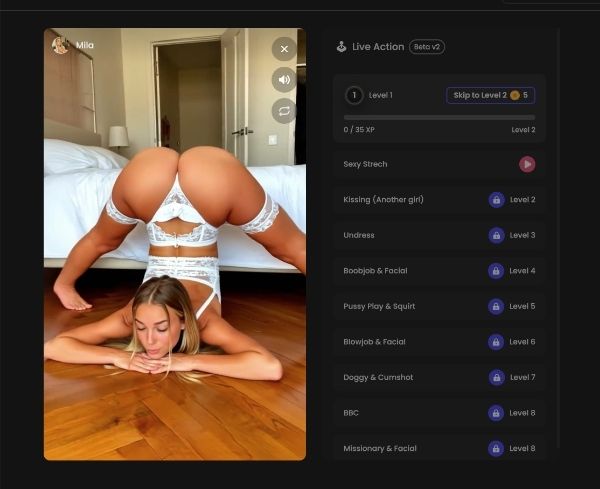
A unique feature of Candy AI is that I saw something called “Live Action, Beta v2.” I sat there looking at it like, “What the fuck is this?” In essence, it seems Candy AI decided to make the system a bit of an RPG where you can’t view or create any content unless you’ve “earned” it: To the right is a meter, along with levels and “touches” which list a number of activities which can be done as you “gain levels.” The first of which appears to be “stretches” and presumably goes into sexual activity the more you level up.
This is presented in a semi-game-like fashion as if Candy AI is saying, “Do a bit of work and this is what you get.” I didn’t see this style of gamification in any of the other products, and it appears to be a form of progression based around emotional investment and rewards psychology.
It’s not just generating videos, you’re on a bit of a journey where you gain experience points and unlock, which felt weird but sort of interesting when I was going through it.
Visit Candy AI
Soulgen Unique Feature
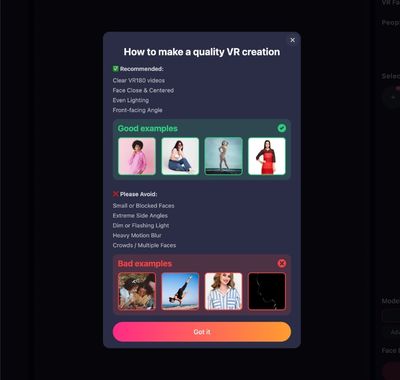
A unique feature of Soulgen is that at one point I came across this image titled “How to make a quality VR creation.” I was sort of thrown by the organized tutorializing of this platform as it sort of read like Soulgen was attempting to educate me on how to make better content before I even clicked generate: This essentially lays out best practices for clear VR180 footage, centering faces, lighting, and shows examples of good versus bad input.
I think that’s really the unique feature here: rather than forcing users to educate themselves through trial and error, Soulgen is telling you how to get quality output. It sort of feels like the developers are saying, “This is what works, this is what doesn’t.” That’s a rather human-centered aspect of a generative AI product. Not only does this help avoid terrible experiences, but it kinda disciplines users into entering better prompts and being better users, which ultimately sort of makes the experience feel less arbitrary.
Visit Soulgen
Candy AI Safety
NSFW filters are tough ones. As you might expect from a more personal or creative AI experience, Candy AI employs a mix of user controls and platform-level filtering to manage the line between freedom and safety. For some, this can feel a bit more edgy or risky, but others prefer the more defined choices than with NSFW filters. It’s a scale of openness vs. caution, and Candy AI tips more towards open.
Soulgen Safety
With Soulgen you are taking a more different approach to safety. This is more of a creative tool, they definitely want you to try and have a specific input, this helps you to try and stay on track with the type of content that you are trying to generate. Yes, you can still select the NSFW buttons, but more so than that is the idea that you are trying to create the content you want with your prompts. The rules of the platform help you and the editor allows you to help yourself keep the output more aligned with your requests, so you have less of a chance of any misfire.
Candy AI Support
The support on Candy AI does appear to be somewhat geared towards relying on a community to share the knowledge on a forum and community platforms where users can assist one another, share any solutions to issues that they have found, as well as share any prompt writing techniques that they have discovered. There does appear to be official support available but at least a large amount of the information that you can gain from the platform will need to come from other users who have spent time on the platform.
Soulgen Support
Soulgen’s support appears to be more based on creative support, tutorials on how to create cleaner images, guides on prompt optimization and documentation about credits and output control. Less therapeutic, more creation enabling.
Conclusion
In a way, Candy AI and Soulgen represent the difference between watercolors and acrylics, both are beautiful mediums for an artist to depict the same scene. The one offers a unique emotional response; the other offers a wider range of colors to work with.
Which one is “better” will always be a matter of personal preference: if you want a more curated chatting experience, then Candy AI is the better choice; but if you want great art, more complex scene generation, and a chatbot that doesn’t overshadow the experience, then Soulgen might be the better choice for you. Both Candy AI and Soulgen are intriguing examples of where AI companion technology is today, and both leave you feeling like you wanted a bit more.